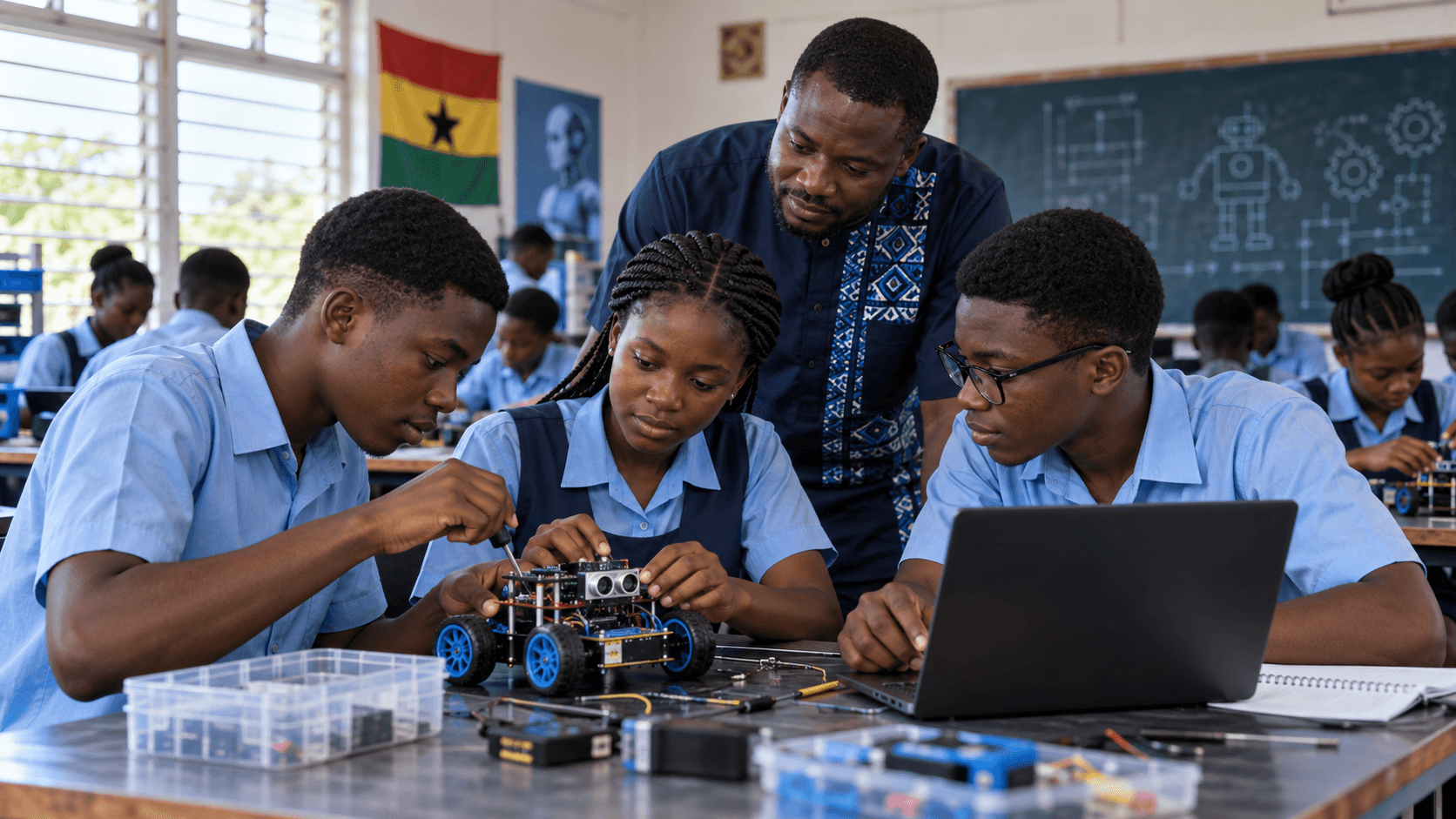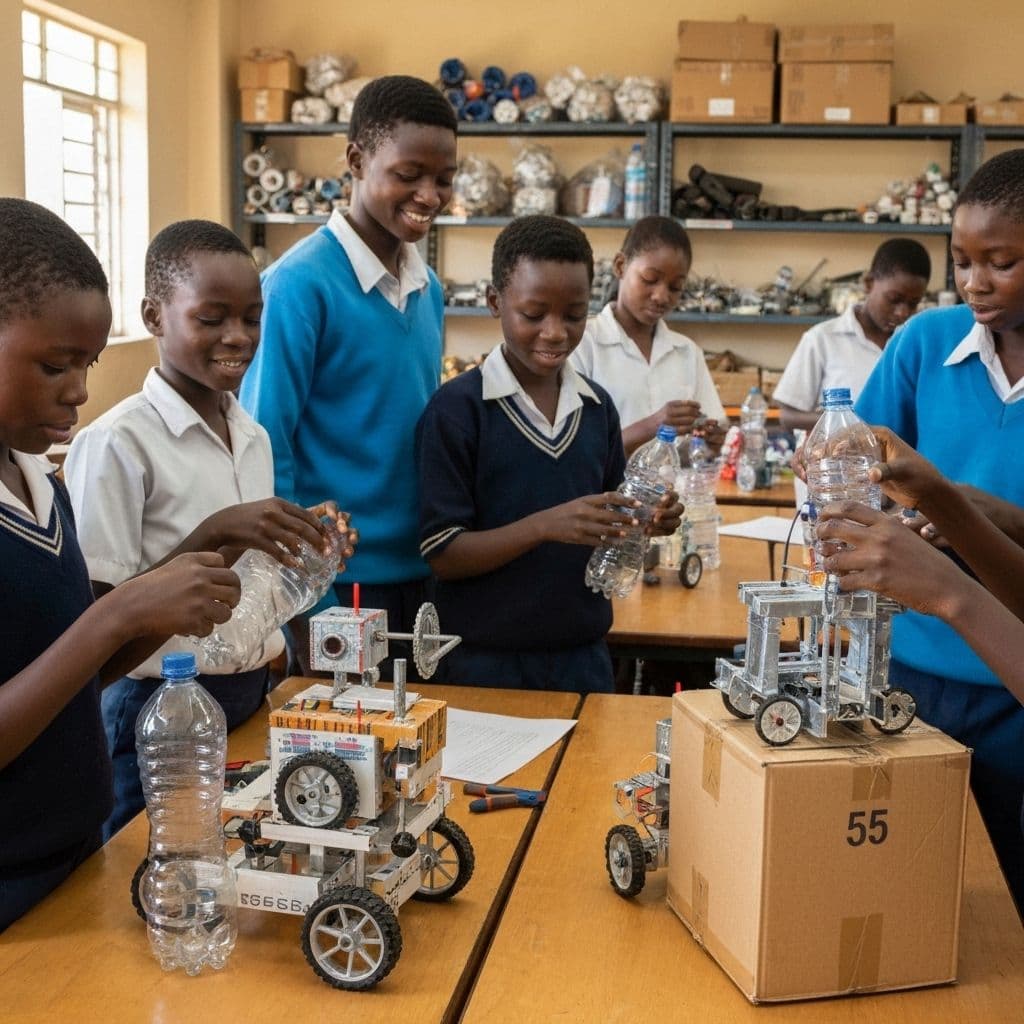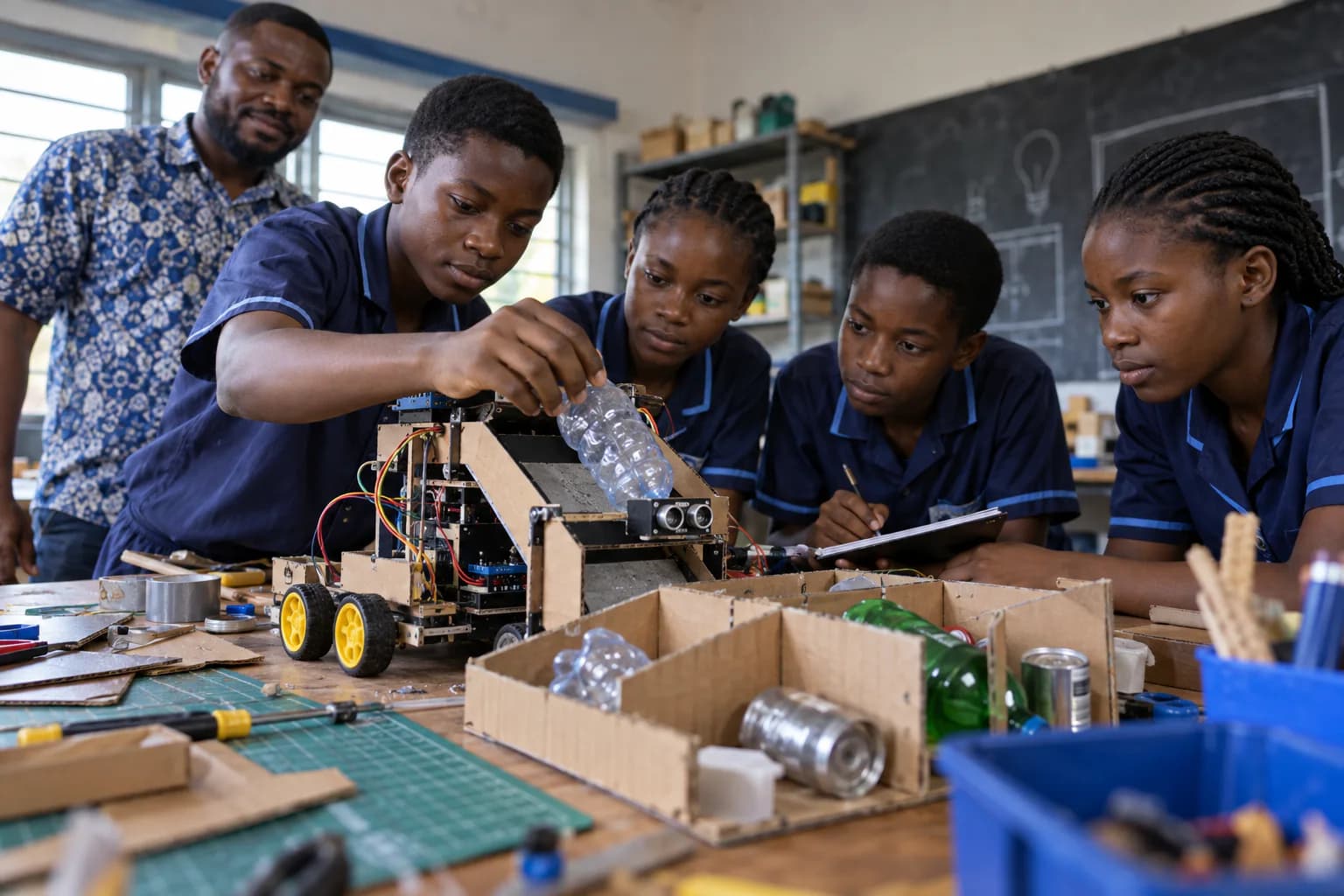
A robot moving across a table can impress a room. The deeper question is what moved inside the learner’s mind. Did the learner define a problem, model a system, select a sensor, predict behaviour, test an idea, interpret failure, and improve the design? Or did the learner reproduce a sequence that had already been decided?
Robotics has enormous educational value because it makes abstract ideas physical. Code produces motion. Measurement affects decisions. Mechanical design changes performance. Teamwork becomes visible. But these benefits do not come automatically with a kit.
When robotics is organised mainly around spectacle, expensive hardware, or a small competition team, it can widen the gap between learners who watch and learners who build. Ghana needs a classroom model of robotics: repeatable, curriculum-connected, repairable, and relevant to the way young people experience their communities.
The robot is not the learning outcome. The learner’s engineering judgement is.
Three tests for a serious robotics programme
- Relevance: Does the challenge connect to a system learners can observe—water, energy, transport, agriculture, waste, accessibility, safety, or classroom life?
- Repairability: Can teachers and learners diagnose faults, replace common parts, improvise materials, and continue learning when something breaks?
- Repeatability: Can an ordinary class run the experience again next term without depending on a visiting expert or a one-time budget?
A programme that fails one of these tests may still produce an exciting event. It is unlikely to produce a durable learning culture.
Begin with the system, not the kit
Good robotics instruction starts by observing a system. Learners might investigate how a water tank overflows, how waste is sorted, how classroom temperature changes, or how a person with limited mobility interacts with a doorway. They identify variables, constraints, users, and consequences before selecting a component.
The classroom loop is simple and demanding:
- Observe the real situation.
- Define a precise, bounded problem.
- Prototype a model with available materials.
- Test it against agreed criteria.
- Explain what failed, what changed, and why.
This keeps technology in its proper place. A bottle, cardboard chute, ruler, and hand-drawn flow diagram may do more intellectual work in the first lesson than a sophisticated robot. Hardware enters when learners can explain what it needs to sense, decide, or control.
Failure must be part of the curriculum
Robotics is one of the best environments for teaching productive failure, but only if speed and perfect demonstrations are not rewarded above reasoning. A robot that does not work can reveal misconceptions about current, friction, logic, measurement, or structure. The teacher’s task is to make that evidence discussable.
Assessment should therefore include design journals, wiring explanations, code walkthroughs, test results, iteration history, teamwork, and ethical reflection. Did the group understand the user? Did they test edge cases? Could they explain the relationship between the physical and digital system?
Equity is an operating choice
A robotics programme is not inclusive because girls and underrepresented learners appear in launch photos. Inclusion is created through group roles, access time, progression, mentorship, assessment, and expectations. Every learner should rotate through building, coding, testing, documentation, and presentation. No student should become the permanent note-taker while another becomes the permanent engineer.
Shared kits can support excellent learning when routines are designed well. Small groups can work through stations for systems thinking, mechanical prototyping, electronics, programming, and communication. The constraint can even strengthen collaboration—provided every learner has a meaningful intellectual role.
What Ghana should scale
We should scale teacher capability, locally repairable kits, curriculum-linked challenge libraries, consumable supply chains, school-based showcases, and communities of practice. National competitions can remain valuable, but they should be the visible edge of a much broader classroom experience.
The ambition is not that every child becomes a robotics engineer. It is that every learner develops the confidence to examine a system, break down a problem, test an idea, learn from failure, and build with others. That is national problem-solving infrastructure.
Download the Robotics Education School Implementation Guide.
Spectacle is not the enemy—but it cannot be the curriculum
A robot moving across a stage can change what a child imagines is possible. That emotional opening has value. The problem begins when the demonstration becomes the programme’s dominant evidence. Spectacle shows what the technology can do; education must show what the learner can now understand, decide and create.
Relevance should increase technical rigour
Locally grounded problems are sometimes dismissed as less advanced than generic competition tasks. In fact, context introduces demanding constraints. A system designed for a farm, market, classroom or drainage channel must confront users, dust, moisture, cost, language, repair and unintended consequences. Relevance forces engineering out of the ideal environment.
Four layers of a meaningful challenge
- Observe: investigate the people and system before proposing a device.
- Model: decide which part of the problem can be represented safely and honestly.
- Build: create and test under explicit constraints.
- Question: examine failure, access, cost and who might be excluded.
The showcase I want to see
I want learners to show the first failed prototype, the evidence that changed their minds and the limitation they have not solved. That presentation is less theatrical and more impressive. It reveals young engineers learning that credibility comes from disciplined inquiry, not from pretending every prototype is a finished solution.
The five-word question I cannot forget
The first time I watched one child touch a robotics kit, he froze and whispered: “So this thing is real?” The question revealed both the power and the failure of exposure. He had encountered robots as an idea to memorise, not a system he could touch, question and eventually build.
That moment is why I value demonstrations but refuse to confuse them with transformation. The first encounter should create wonder. The next experience should create competence. The experience after that should create independence.
InovTech’s field reflections now sit behind headline reach of 25,000+ learners and 100+ schools. The number that matters next is how many learners cross from “this is real” to “I understand it,” and finally to “I can build something Africa needs.”