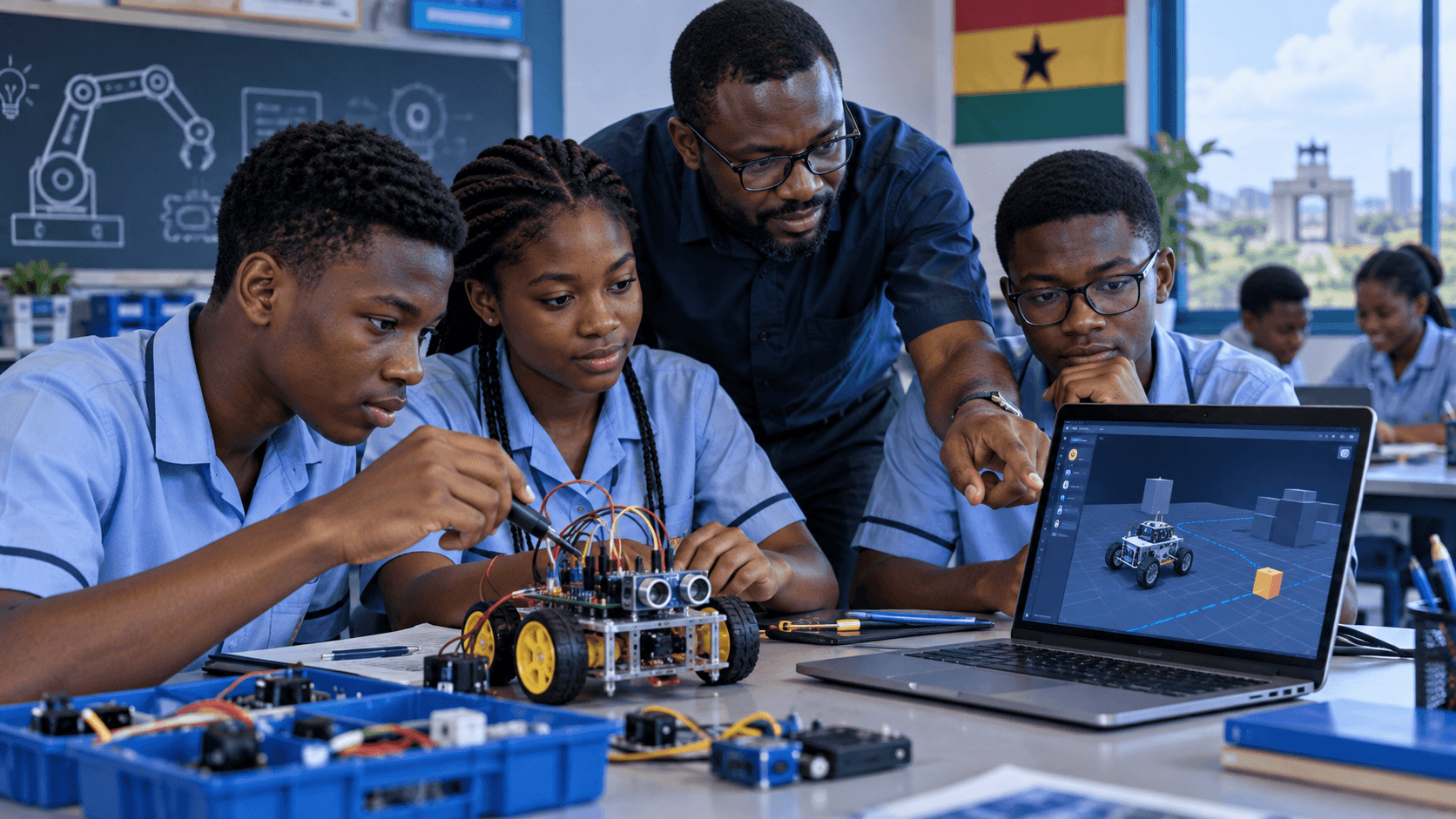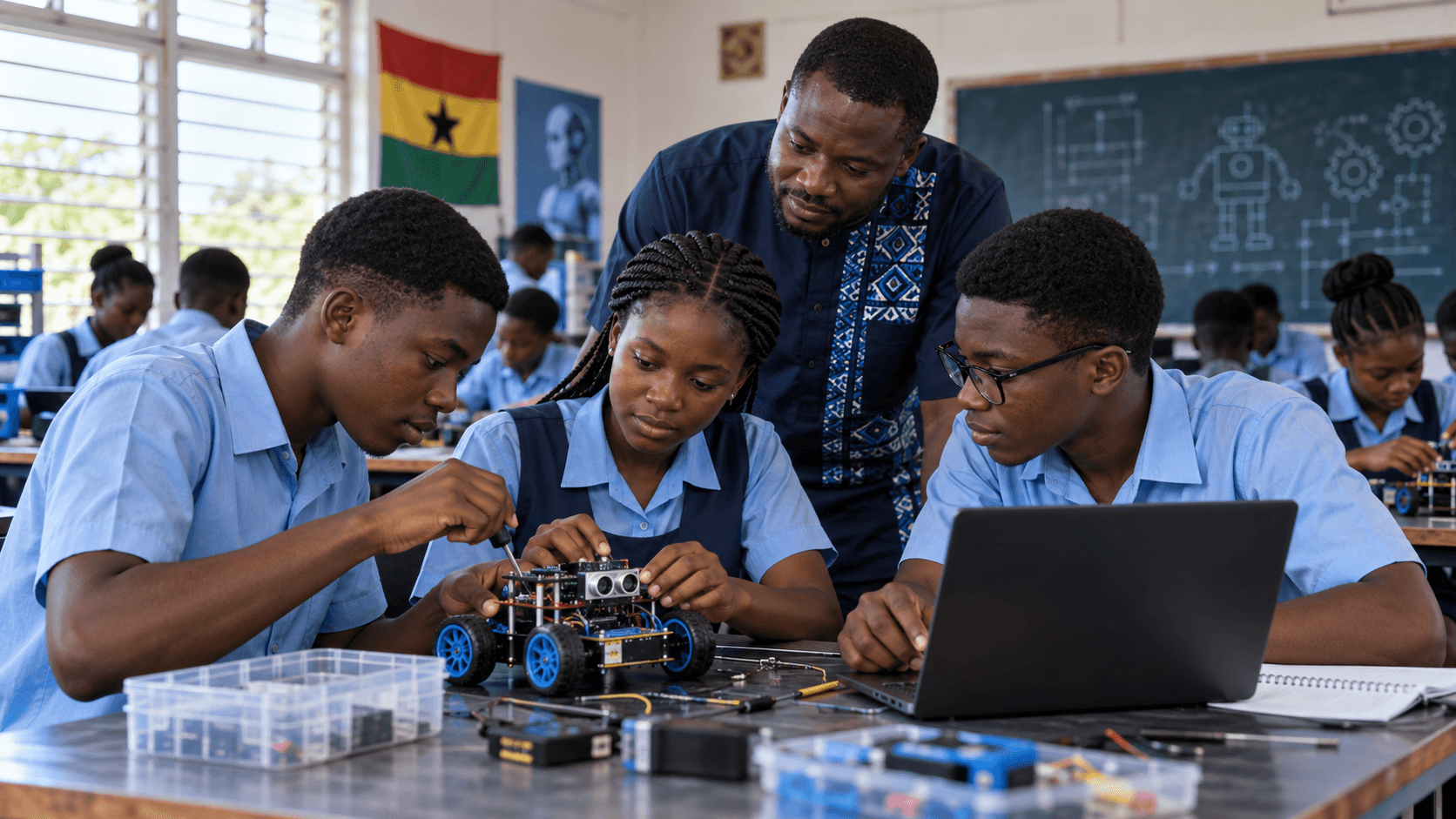
Robotics education in Ghana has moved from novelty toward a visible field. Schools run clubs, learners enter competitions, organisations deliver outreach, universities support technical work and robotics now has a place in the secondary curriculum. That growth should be recognised. It should not be confused with maturity.
The next phase is not more robotics activity. It is stronger progression between activities, classrooms, institutions and careers.
What is driving the growth
Four forces are converging. Families and schools increasingly see computing and engineering as future-facing capabilities. Lower-cost electronics and visual programming tools have reduced the entry barrier. Competitions create motivation and public visibility. Ghana's curriculum direction now gives robotics a clearer educational home.
Organisations such as InovTech and other school, university and community initiatives have also demonstrated demand beyond a small elite. Learners engage deeply when robotics connects abstract science and mathematics to a system they can observe, test and change.
The five-stage maturity model
- Exposure: demonstrations and short workshops create curiosity.
- Participation: clubs and competitions provide repeated contact.
- Curriculum: learning outcomes, progression and assessment enter normal teaching.
- Capability: trained educators, maintained tools, laboratories, communities of practice and advanced pathways become dependable.
- Industry connection: learners move into research, apprenticeships, products, automation and robotics enterprises.
Much of Ghana's activity sits between stages two and three. The strategic task is to make stages four and five real.
The fragmentation problem
A learner may attend several beginner workshops without progressing beyond basic assembly or block coding. Schools may purchase incompatible kits. Teachers may receive training without coaching. Competition teams can become highly capable while the rest of the school remains untouched.
Ghana needs portable capability milestones: what learners understand, can build, can debug and can explain at each stage. Providers can use different platforms while recognising common evidence.
Teacher capability is the binding constraint
A sustainable programme cannot rely indefinitely on visiting specialists. Schools need teacher teams who can facilitate design, troubleshoot common faults, connect projects to curriculum and assess reasoning. Training should include classroom rehearsal, coaching and evidence from implementation—not only tool orientation.
Robotics must connect to Ghanaian problems
The most powerful projects begin with systems learners can observe: water management, waste, mobility, agriculture, accessibility, energy or school operations. Local relevance is not a decorative theme. It introduces real constraints, users and consequences that make the engineering more demanding.
What should happen next
- Publish a visible primary-to-tertiary robotics progression.
- Create regional educator communities with coaching and shared project banks.
- Adopt interoperability and repairability standards for publicly funded equipment.
- Connect competitions to curriculum, documentation and year-round learning.
- Link schools to universities, technical institutes and industrial problems.
- Track who advances into technical leadership—not only who attends.
- Use virtual laboratories to increase practice while preserving hands-on engineering.
The measure of the next phase
Ghana will know robotics education is maturing when a learner can begin in an ordinary school, progress through increasingly complex systems, find skilled mentors, enter advanced study or production and return knowledge to the next cohort. Growth has created the opening. Infrastructure of progression must now turn it into national capability.
A district-level robotics implementation blueprint
A district does not need to equip every school identically on day one. It can build a tiered network:
- Every-school layer: unplugged engineering, coding access, simple electronics and a trained teacher team.
- Cluster layer: shared physical kits, coaching, competitions tied to curriculum and scheduled advanced sessions.
- Regional hub: fabrication, advanced sensing, repair, teacher certification and university or industry collaboration.
- Virtual layer: simulation and project resources available across all tiers to increase practice frequency.
This architecture concentrates expensive capabilities without concentrating all opportunity. Transport, scheduling and progression between tiers must be budgeted as seriously as equipment.
The programme health scorecard
Score each dimension from one to four every term:
- Access: how many learners receive meaningful technical time—not demonstrations?
- Progression: are challenges becoming conceptually harder?
- Teacher ownership: can school staff deliver and adapt sessions independently?
- Equipment health: what proportion is functional and how long do repairs take?
- Inclusion: who codes, builds, tests and leads?
- Curriculum connection: which mathematics, science and computing outcomes are strengthened?
- Evidence: can the programme show learner artefacts, explanations and transfer?
A low score should trigger a specific recovery plan. The tool is valuable because it reveals when public excitement is hiding institutional weakness.
A teacher capability ladder
Facilitator: delivers a tested activity safely. Adapter: changes constraints and supports different learners. Designer: creates curriculum-connected projects and assessments. Coach: observes colleagues and improves practice. System leader: manages equipment, evidence, partnerships and progression across schools.
Training budgets should state which level they are developing and how performance will be demonstrated. A two-day workshop may begin facilitator confidence; it cannot honestly certify system leadership.
The learner progression evidence
At each stage, preserve one portfolio record: the design brief, annotated code, test evidence, failure analysis and a short explanation of trade-offs. By senior high school, a learner should be able to show not just several robots, but a visible evolution in systems thinking—from following a sequence to designing under uncertainty.