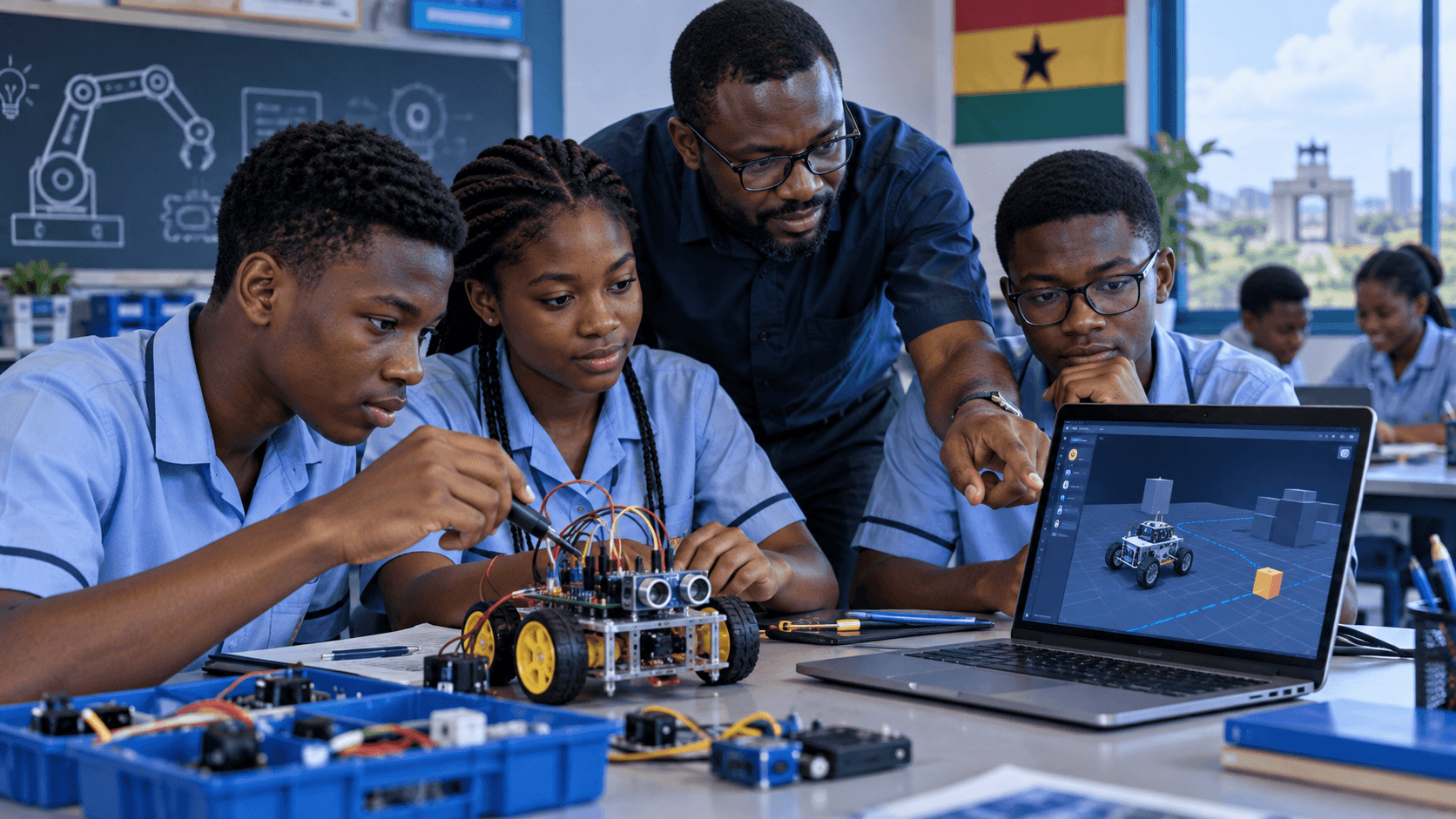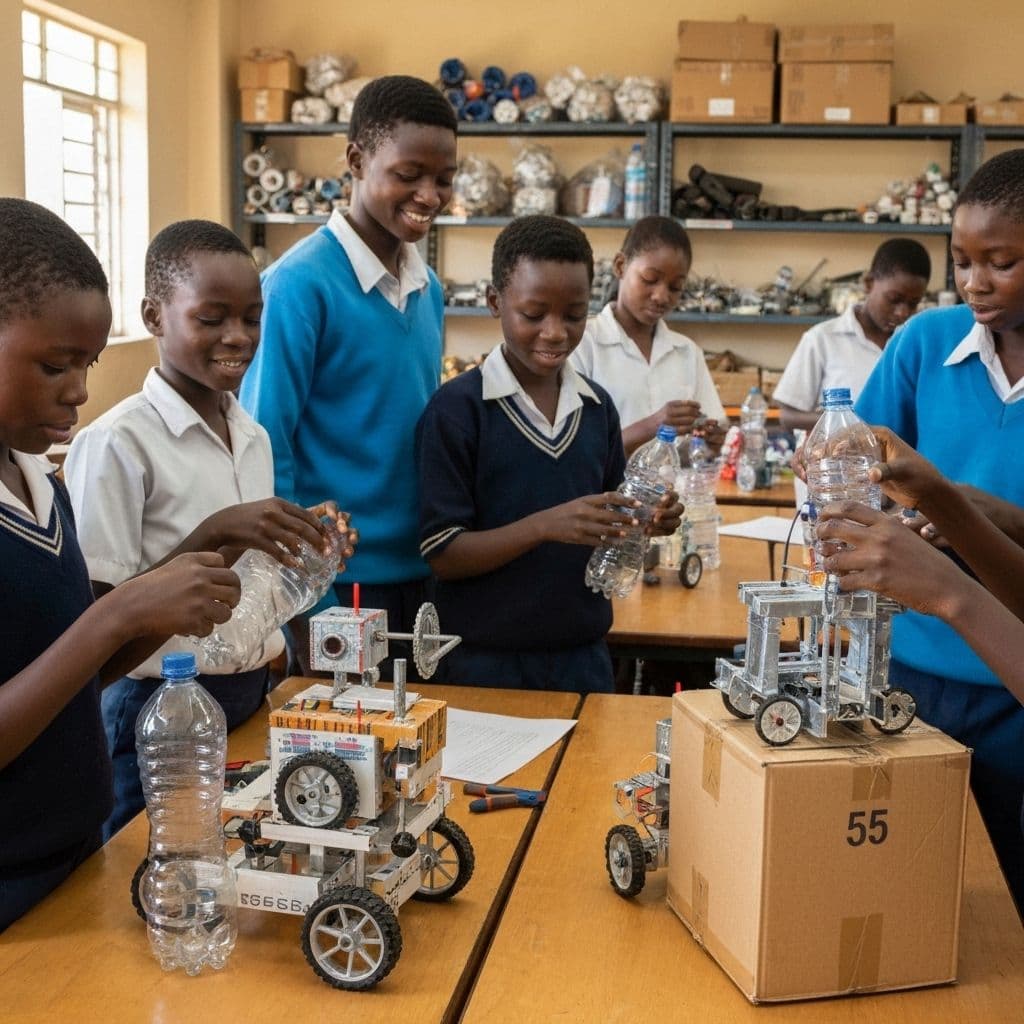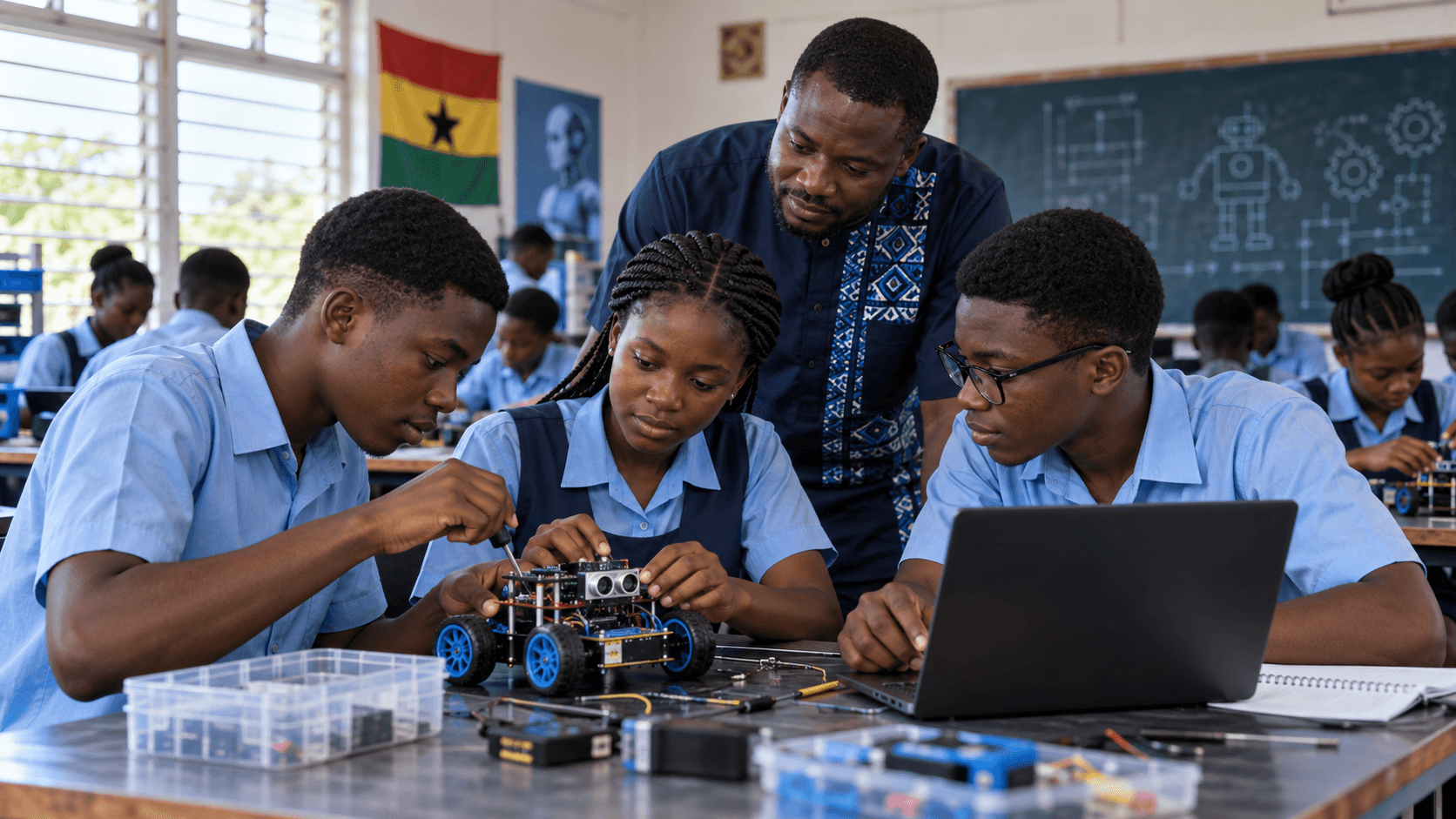
Robotics education becomes valuable when the robot stops being the star of the lesson. The real outcome is a learner who can observe a system, define a problem, build a model, test an assumption, interpret failure and explain an improved decision. Ghana now has a secondary robotics curriculum. The strategic task is to build the teacher capability, progression and operating model that make that ambition real in ordinary schools.
This guide is for school leaders, teachers, foundations and companies deciding how to introduce or strengthen robotics. It does not begin with a shopping list. It begins with the learning system the equipment must serve.
A robotics programme should be designed backwards from learner capability—not forwards from a box of components.
1. Define the learning promise
Before selecting a kit, write down what learners should be able to understand, make and explain after one term. A serious programme develops more than assembly skills. Learners should encounter mechanics, sensing, control, computational thinking, measurement, design, teamwork and ethical decision-making.
A useful learning promise might be: “Learners will investigate a local system, develop and test a robotic response, document their iterations and defend the trade-offs in their final design.” That sentence gives a school a stronger procurement test than “students will learn robotics.”
2. Build progression across four stages
- Systems and sequence: learners model inputs, decisions and outputs using stories, cards, mechanisms and unplugged activities.
- Guided physical computing: learners connect code to sensors, lights, sound and motion while learning safe routines and debugging.
- Open engineering challenges: teams make design choices under constraints and test against agreed criteria.
- Public problem-solving: learners work with users, evidence and consequences—not only technical performance.
The stages should be visible across year groups. If every class starts again with the same line-following robot, the school owns equipment but not a pathway.
3. Choose locally meaningful challenges
Ghanaian learners can investigate water storage, waste sorting, road safety, accessibility, energy use, food systems, coastal conditions or classroom ventilation. Relevance is not decoration. A real context forces learners to consider users, environments, costs and unintended consequences.
The challenge must remain bounded enough for the available time and tools. A class does not need to “solve flooding.” It can model a water-level alert, compare sensor placement or test how debris changes a drainage prototype.
4. Design the complete operating model
Every sustainable programme answers six operational questions:
- Where will equipment be stored, charged and inventoried?
- Which parts are consumable, replaceable or repairable locally?
- How many learners will share a kit, and how will roles rotate?
- When will teachers plan, practise and receive coaching?
- How will the programme continue during power, device or internet failure?
- What evidence will show learning, not merely attendance?
Shared equipment can support deep learning when roles are designed deliberately. Builder, programmer, tester, documenter and presenter should rotate. No learner should become the permanent observer.
5. Make teacher capability the first investment
Teachers do not need to know every answer before beginning, but they need confidence with the learning cycle. Preparation should include assembling and troubleshooting the actual kit, anticipating misconceptions, facilitating productive failure, connecting projects to curriculum and assessing explanations.
A launch workshop is not enough. Strong implementation includes rehearsal, classroom observation, coaching and a community of practice. The question is not whether the trainer delivered the content. It is whether the teacher can adapt the next lesson without the trainer present.
6. Assess engineering judgement
Use design journals, annotated code, wiring explanations, test tables, iteration histories, peer critique and demonstrations. Ask learners to predict before running, explain why a failure occurred, change a design for a new condition and identify who might be affected by the solution.
Competitions can motivate teams, but speed and polish should not displace evidence, inclusion and reasoning. The strongest showcase makes the learning process visible.
A 12-question readiness check
Before approval, confirm that the programme has a curriculum connection, learner progression, teacher owner, timetable allocation, safe storage, maintenance route, consumables budget, offline plan, inclusive group roles, assessment rubric, implementation support and end-of-term review.
Download the Robotics Education School Implementation Guide.
The decision
Ghana does not need to choose between ambitious technology and practical implementation. We need programmes ambitious enough to develop engineering judgement and practical enough to survive ordinary school conditions. Robotics becomes national capability when it moves from an event into a dependable pathway.
The strategic mistake: treating robotics as a new subject instead of a new way to think
Robotics is often placed at the edge of the school: an after-class club, a competition team or a room that opens when visitors arrive. That positioning limits its educational value. Robotics is most powerful when it becomes a practical language for mathematics, science, computing, design and civic problem-solving. A sensor can make measurement visible. A failed mechanism can turn force and friction into questions learners care about. A control system can make logic consequential.
This is why a school should not ask, “Where can we fit robotics?” It should ask, “Which concepts do learners repeatedly struggle to understand, and where could a programmable physical system make those concepts observable?” The second question connects robotics to the instructional core rather than adding another activity to an already crowded timetable.
A maturity model for school leaders
Most programmes move through four levels. At the exposure level, learners watch or reproduce a demonstration. At the participation level, they assemble and code with guidance. At the capability level, they diagnose failures, select components and defend design decisions. At the transfer level, they apply their engineering judgement to unfamiliar problems and constraints. A serious strategy should name the level it is funding and the evidence required to progress.
The danger is confusing excitement at level one with capability at level three. Excitement matters, but it is an opening condition—not proof of learning. The question after every impressive showcase is: what can these learners now do without the script, the trainer or the exact kit?
What I would inspect during a school visit
- Can a learner explain why the robot behaved as it did, or only repeat the build steps?
- Can the teacher modify the challenge for a different ability level?
- Are girls and quieter learners rotating through technical roles?
- Does the inventory show which parts fail and how quickly they are replaced?
- Is learner work becoming more complex across terms, or restarting at beginner level?
Those questions reveal more than the price or brand of the equipment. They show whether the school has built a learning system.
The national opportunity
Ghana can build a robotics pathway that is recognisably Ghanaian: curriculum-aligned, grounded in local systems, rigorous about engineering and realistic about infrastructure. That would move the conversation beyond importing kits toward cultivating young people who can understand and redesign the systems around them. The strategic asset is not the robot. It is a generation trained to look at a complex problem and believe it can be modelled, tested and improved.
From the field: the question that became a strategy
In 2019, after a weekend coding club in Accra, a 15-year-old waited until the room had emptied and asked me: “Why do all the tools we use come from outside? Will Ghana ever build one?” I could not give him an answer that satisfied me. The question helped sharpen InovTech’s mission: learners should not only operate imported systems; they should grow into people capable of designing the tools Africa needs.
That learner is now studying AI engineering. The story matters because it shows what a pathway can do. One workshop did not create the outcome. Curiosity was followed by continued access, increasingly demanding work and a visible future. Today, InovTech’s wider work has reached 25,000+ learners, trained 2,500+ educators and engaged 100+ schools. Those numbers are not the conclusion; they are the responsibility to make progression real at scale.
Read the original field reflection. My prediction is that the most influential African robotics programmes of the next decade will be judged less by the brands they import and more by the systems, curricula and tools their learners eventually originate.