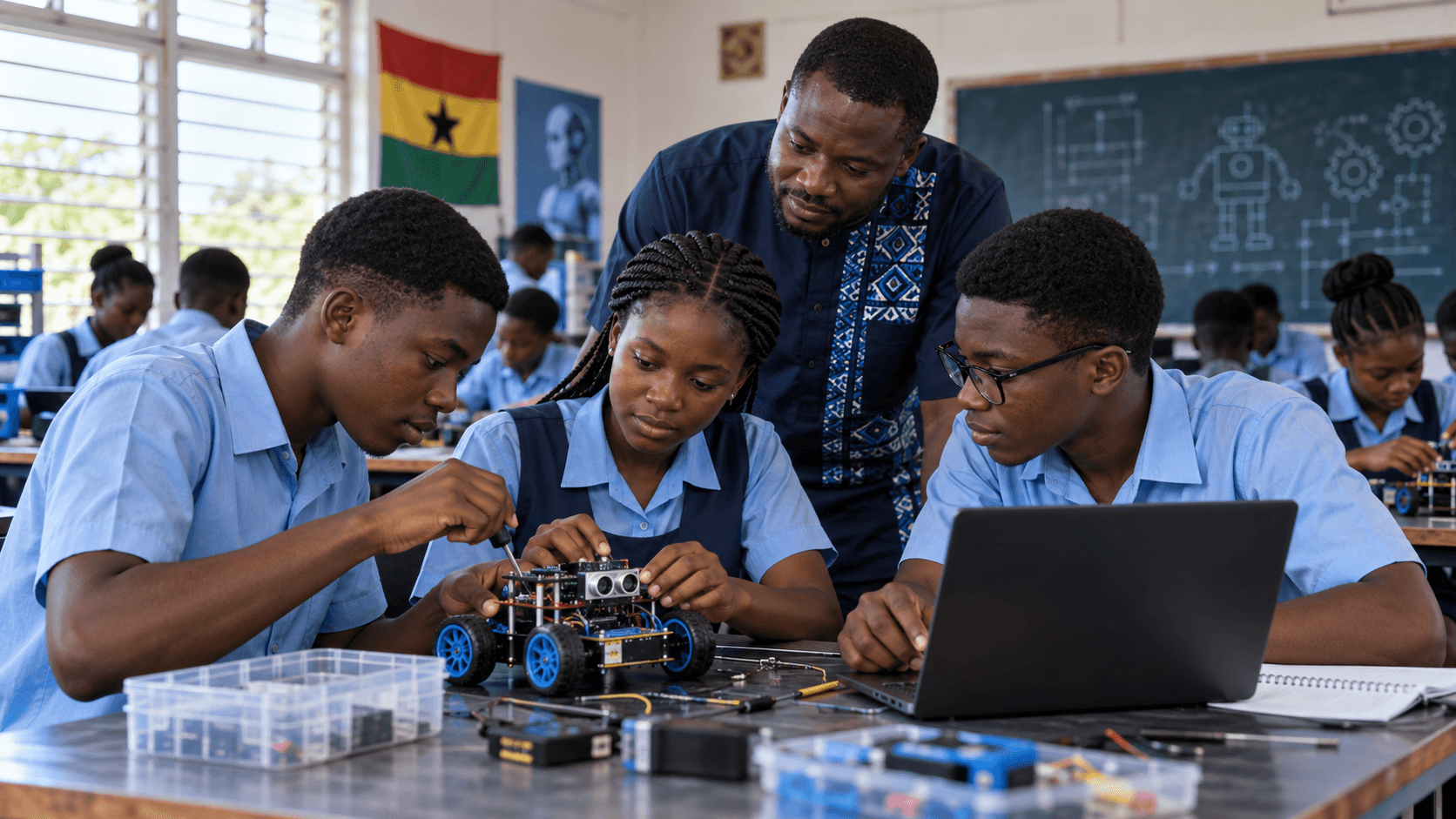
Robotics in Ghana is not one industry yet. It is an emerging network of education providers, competition teams, university laboratories, individual builders and organisations exploring physical automation. Mapping it accurately requires separating activity types instead of treating every workshop or prototype as a company.
This October 2026 directory is non-exhaustive and not a ranking. Inclusion reflects publicly verifiable activity; readers should confirm current programmes with each organisation.
School robotics and capability providers
InovTech STEM Center works with schools through robotics, coding, laboratories, curriculum and educator development. KodeVR expands virtual access to robotics, electronics, coding and 3D design. The Ghana Robotics Academy Foundation has contributed to robotics education and competitive pathways. Other school networks, independent educators and STEM organisations add important regional activity.
Competitions and communities
Competitions can expose learners to teamwork, constrained design and public demonstration. Their long-term value depends on whether preparation connects to year-round curriculum, documentation and progression. Ghanaian participation in national and international robotics challenges provides visibility; the ecosystem should also capture what teams learn and make reusable resources available to schools.
Universities and research
KNUST, Academic City University College, Ashesi University, the University of Ghana and technical universities support relevant work across engineering, computer science, embedded systems, autonomous systems and applied research. The strongest future projects will connect disciplines and remain active beyond a final-year demonstration.
Industrial and applied robotics
Ghana's visible robotics ecosystem is currently more developed in education than in locally supplied industrial robotics. Potential applications exist in mining, ports, warehousing, agriculture, infrastructure inspection, health logistics and environmental monitoring. This part of the directory should eventually distinguish end users, integrators, maintenance providers and original product companies.
The evidence standard for inclusion
- a functioning Ghana-based programme, laboratory, project or company;
- a clear robotics or physical-automation component;
- public evidence more recent than an announcement;
- a named team, institutional owner or maintenance route; and
- clarity about whether the work is educational, research or commercial.
What the map currently reveals
Ghana has strong enthusiasm, growing curriculum legitimacy and islands of advanced capability. It has weaker visibility around industrial demand, systems integration, safety, component supply, maintenance and research commercialisation. That gap is not evidence that nothing exists; it is evidence that the ecosystem needs better documentation and connection.
A shared national robotics registry
A useful registry would record organisations, capabilities, equipment, research topics, regions served, active projects, partnership needs and current evidence. It could help schools find credible providers, universities share facilities and industry issue real challenge briefs.
Sources and related reading
- NaCCA: Secondary Education Robotics Curriculum
- The State of Robotics in Ghana
- Can Ghana Build a Robotics Industry?
- InovTech STEM Center and KodeVR
The capability categories a serious robotics map needs
- robotics education and teacher development;
- competitions and learner communities;
- mechanical design and fabrication;
- electronics, embedded systems and control;
- computer vision, autonomy and simulation;
- systems integration and industrial automation;
- maintenance, parts and field service;
- safety, cybersecurity and standards; and
- university and public-interest research.
Mapping capabilities makes the resource useful to an industry buyer or research partner. A list organised only by organisation name does not.
The laboratory record
For each university or institutional laboratory, capture research themes, equipment, lead investigators, student level, collaboration policy, active projects, publications, datasets, technical services and whether external teams can access facilities. Update the record annually. This can reduce duplicate equipment purchases and make scarce infrastructure more productive.
A buyer's first-conversation checklist
- Show us a system operating outside a controlled demonstration.
- Which conditions cause performance to degrade?
- Who performs installation, calibration and preventive maintenance?
- Which replacement parts are locally available?
- What safety assessment and emergency control exist?
- How is operational data secured and retained?
- What is the full three-year cost, including downtime?
- Which staff capabilities must the buyer develop?
The school-provider evidence standard
Education providers should report curriculum alignment, teacher capability model, learner-to-equipment ratio, practice frequency, progression, equipment uptime, inclusion across technical roles and evidence of independent learner work. Competition medals and attendance numbers can supplement this evidence; they cannot replace it.
The research-to-industry bridge
Each promising project should have a technical readiness assessment, user and market owner, safety plan, intellectual-property route, field-testing partner and next funding decision. Universities can create translational engineering fellowships that pay graduates to turn strong student projects into documented, testable systems.
Priority gaps the directory should actively investigate
Field maintenance outside Accra, rugged components, agricultural robotics, mine and infrastructure inspection, assistive systems, regional safety expertise, applied-control research and buyers willing to fund discovery are high-value areas for deeper mapping.