I began learning about technology in a place where access could not be taken for granted. Growing up in Teshie, I encountered computing more as a promise than an everyday resource. At thirteen, frustrated by learning about computers without meaningful access to them, I began teaching myself through an internet café.
This story is sometimes presented as a lesson in individual determination. It is that—but the more important lesson is systemic. Curiosity was present. The pathway was missing.
I do not build technology because access solved everything for me. I build because I learned how much talent is lost when access, practice and progression do not meet.
The first lesson: proximity changes the question
When you have experienced exclusion, you ask different product questions. Can a learner use this on the device already available? Can a teacher operate it after the trainer leaves? What happens without reliable internet? Does the programme reveal capability in students who have never had the chance to practise?
These questions eventually shaped InovTech STEM Center: not as a collection of robotics events, but as an effort to build practical pathways into coding, electronics, engineering and artificial intelligence.
Teaching robotics revealed the real infrastructure
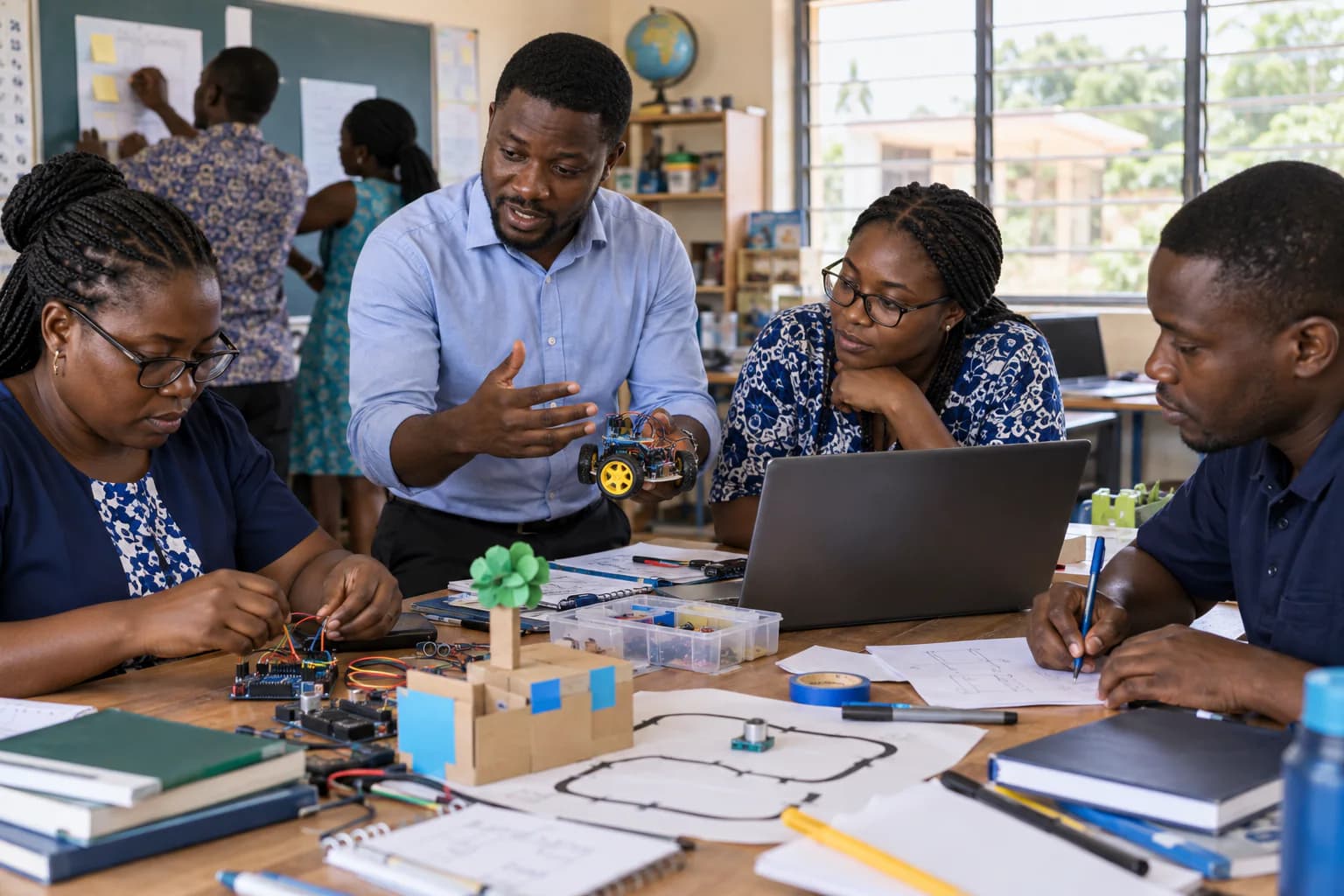
A robotics kit can attract attention. The deeper infrastructure is human: teacher confidence, learner progression, maintenance, curriculum, time, evidence and belief. Across programmes that have reached more than 25,000 learners, trained over 2,500 educators and engaged more than 100 schools, I have learned that the launch is usually the easiest part.
The durable work is helping an ordinary school sustain meaningful practice after excitement fades.
KodeVR emerged from an access contradiction
Physical robotics matters. Learners should eventually confront real materials, friction, wiring, tolerances and failure. But physical equipment is not always available at the frequency learning requires. KodeVR responds to that contradiction by making virtual robotics, coding, electronics, 3D design and AI learning accessible through existing devices.
The principle is not “virtual instead of physical.” It is more practice, wider access and a clearer bridge toward material engineering.
Artificial intelligence changed the scale of responsibility
AI expands what a small team can build, but it also magnifies weak judgement. In education especially, convenience can conceal privacy risks, bias, fabricated information and reduced learner agency. Becoming an AI engineer therefore means more than using models. It means designing data flows, evaluation, human oversight and failure boundaries.
What Ghana taught me about product design
- Constraints are part of the specification.
- Teachers and institutions are product users even when the learner holds the screen.
- Access without progression creates repeated beginnings.
- Local relevance must enter the problem definition, not merely the imagery.
- Scale without evidence can multiply activity while hiding weak learning.
- A product becomes infrastructure only when people other than the founder can sustain it.
The work is becoming larger than education technology
My focus remains young people, teachers and learning systems, but the underlying work is broader: how Ghana and Africa build technological capability instead of remaining consumers of systems designed elsewhere. Education is where that capability begins. Products, companies, public institutions and policy are where it becomes economic and civic power.
The next chapter
I want the learner in Teshie, Tamale, Takoradi or any African community to encounter technology not as a distant object but as a language they can understand, question and use to build. I want teachers to feel like leaders of technological change. I want Ghanaian companies to create systems that travel because they were engineered honestly around difficult realities.
The journey from the internet café did not teach me that one person can overcome every barrier. It taught me that we should build fewer barriers—and stronger pathways.