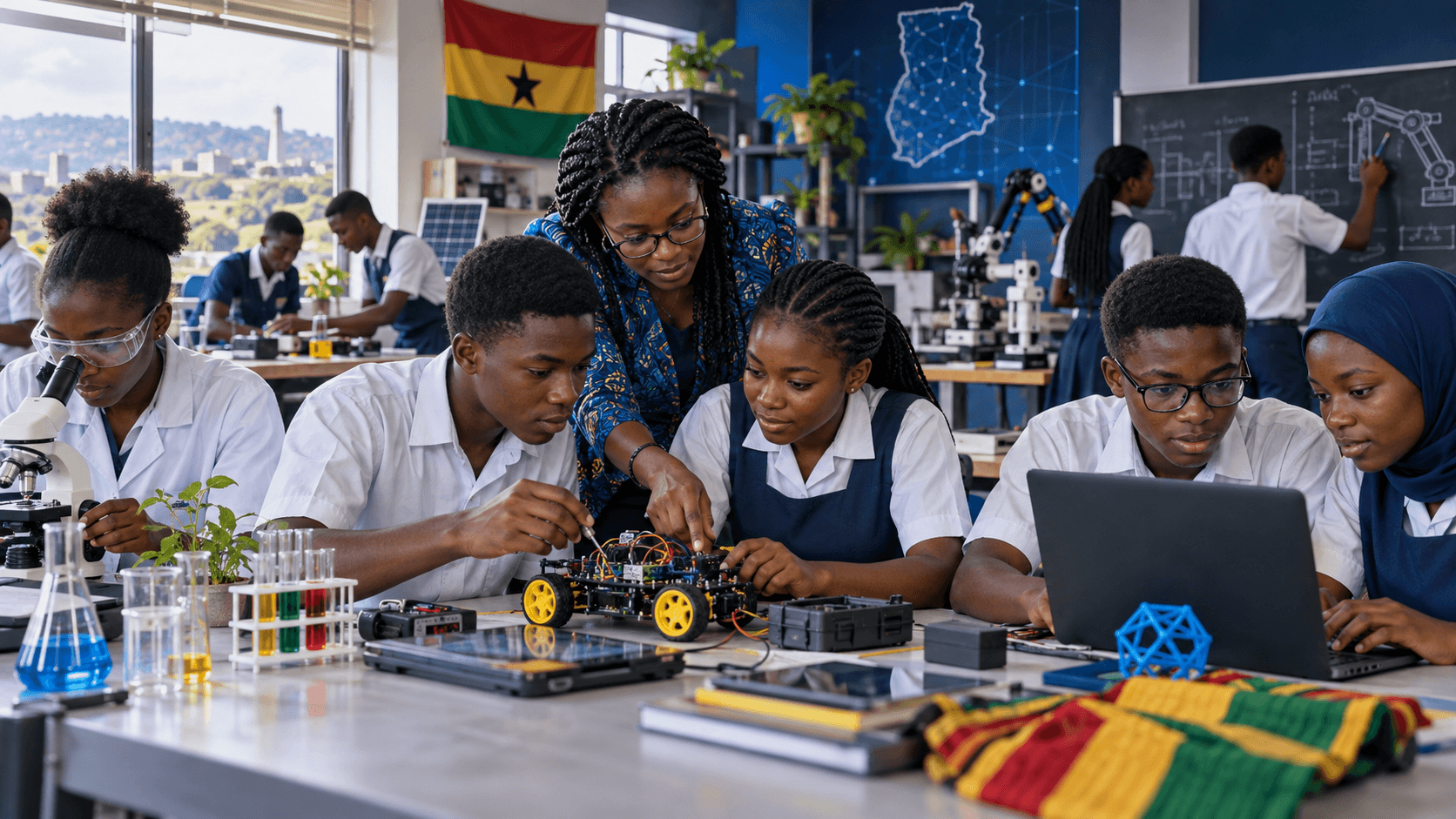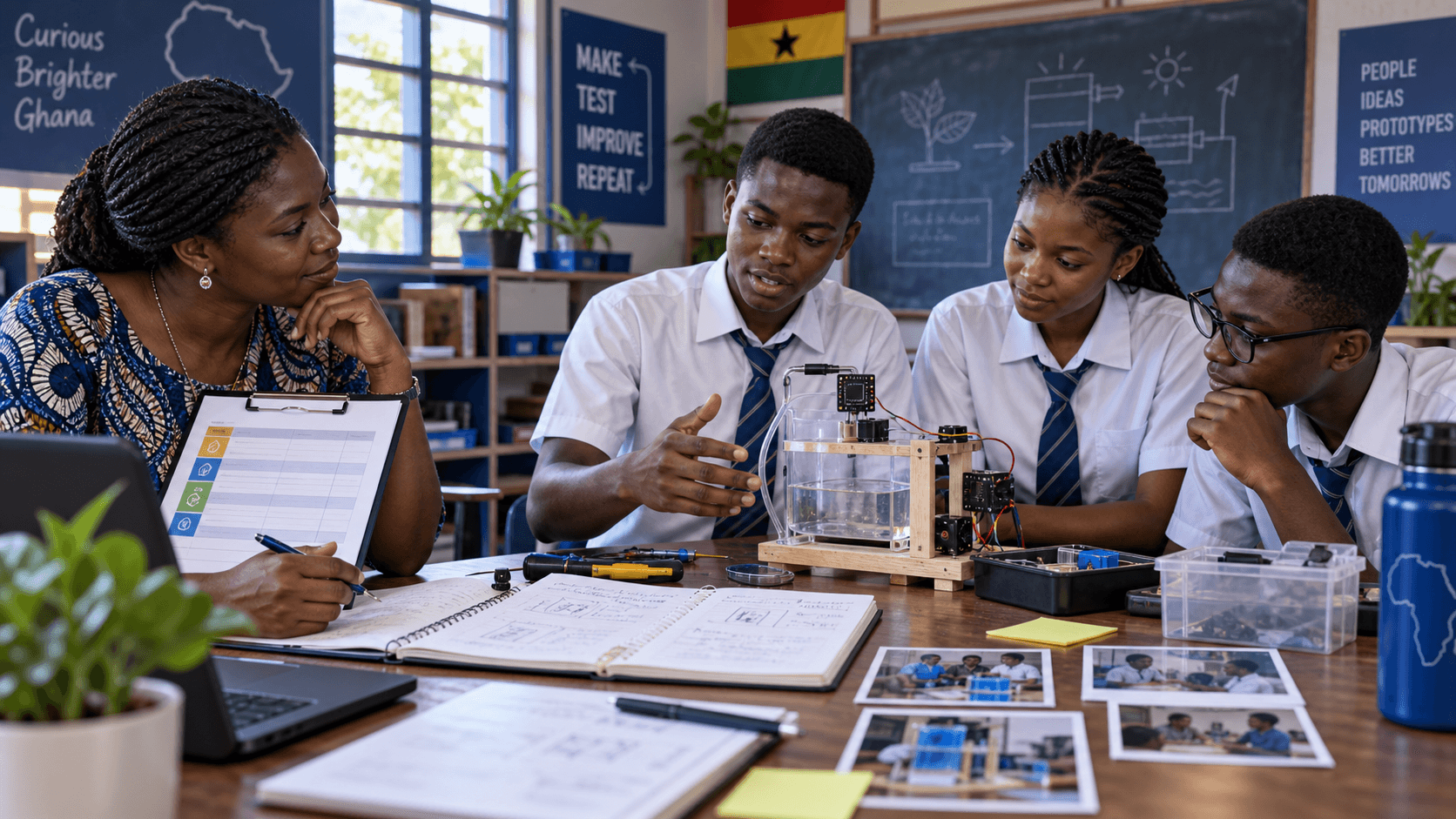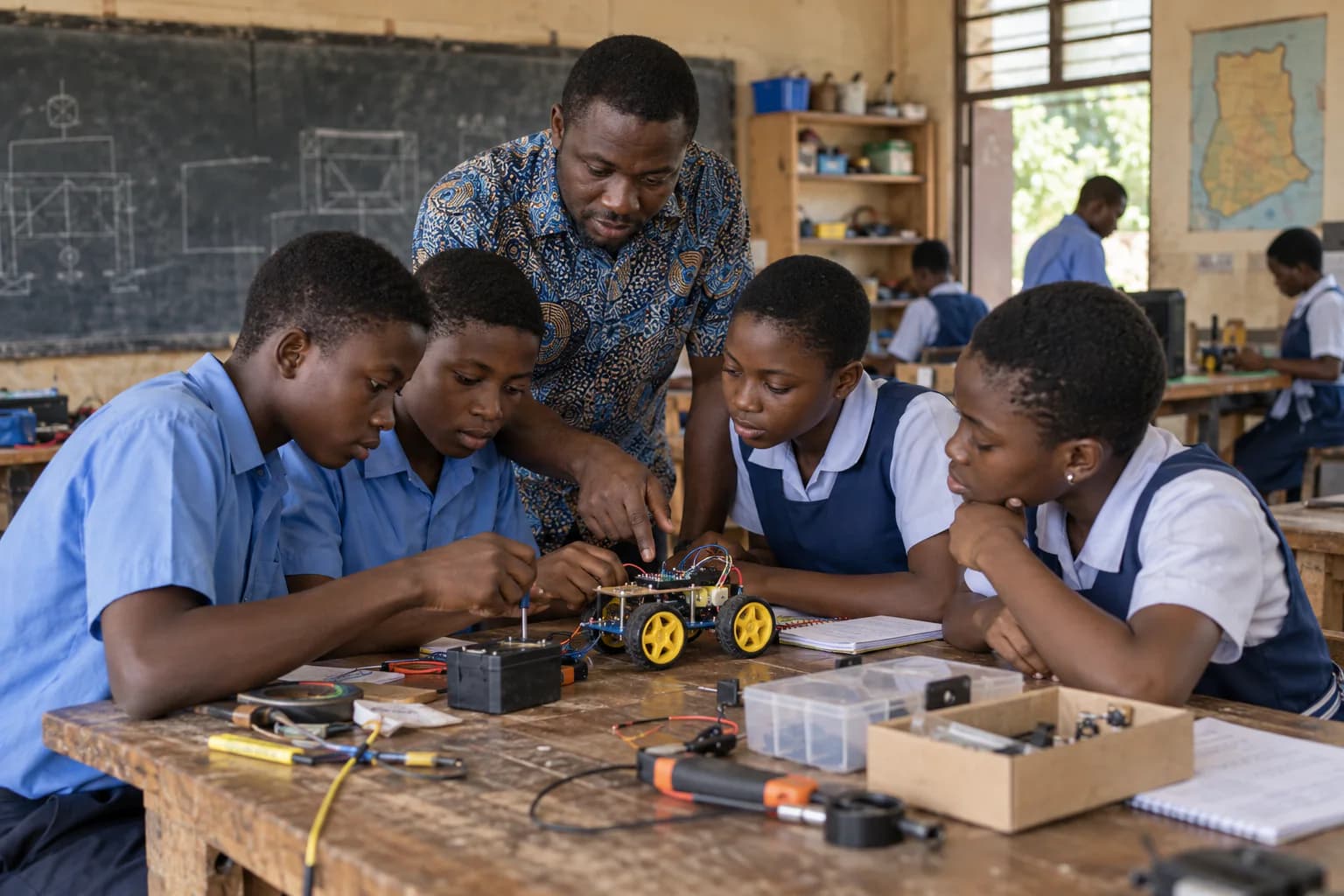
Ghana has spent years discussing access to computers. The next conversation must be about access to capability. A room full of devices can be opened, commissioned, photographed, and still make little difference to how learners think. The real measure of a computing programme is whether a learner can move from using a device to understanding systems, solving problems, building useful things, and explaining the choices behind the work.
This is not an argument against infrastructure. Schools need reliable devices, power, connectivity, safe storage, maintenance, and technical support. It is an argument against treating infrastructure as the outcome. A computer lab is an input. Learner agency is the outcome.
Ghana already has an important curricular foundation. Computing appears in the primary curriculum, continues through the Common Core Programme, and now sits alongside subjects such as robotics and engineering in the secondary curriculum. The opportunity is to turn those documents into a coherent learner journey that survives changes in school, teacher, device, and connectivity.
A computer lab can be photographed. Capability must be observed.
The missing middle is progression
Too many programmes are organised around one-off exposure: a coding day, a robotics demonstration, a donated lab, or a short holiday camp. Exposure can spark interest, but interest without a next step quickly becomes frustration. Learners need to know what comes after the first animation, the first circuit, or the first robot movement.
I use a four-stage pathway to think about this progression:
- Access: learners can regularly reach a functioning device, tool, or unplugged computing activity.
- Practice: they build fluency through repeated routines—decomposition, sequencing, debugging, collaboration, and reflection.
- Application: they use those routines to investigate a real need in their school or community.
- Agency: they make design decisions, defend their reasoning, improve their work, and help others learn.
Each stage depends on the one before it. Giving a learner access to sophisticated hardware without time to practise creates a demonstration culture. Teaching syntax without application creates recall, not capability. Asking learners to build solutions without agency turns projects into copied instructions.
What a national pathway should make visible
A Ghanaian computing pathway should be legible to learners, teachers, parents, school leaders, and partners. At every stage, it should answer four questions: What should learners understand? What should they be able to make? How should they explain their thinking? What is the next level of challenge?
At upper primary, that may mean sequencing, patterns, responsible device use, and block-based creation. At junior high, learners should work with data, physical computing, networks, and more demanding debugging. At secondary level, they should be able to combine software, electronics, design, and domain knowledge to build and evaluate complete systems.
The pathway must also work when hardware is shared and internet access is inconsistent. Computational thinking can begin with cards, classroom routines, role-play, paper prototypes, and locally stored software. The principle is continuity: every lesson should strengthen a way of thinking that can later transfer to a more powerful tool.
Five decisions for school and system leaders
- Map progression across years. Do not let every new teacher or programme restart learners at “what is a computer?”
- Protect regular practice time. A dependable weekly rhythm is more valuable than occasional spectacle.
- Build teacher teams, not isolated champions. Capability should survive staff transfers and leadership changes.
- Assess artefacts and reasoning. Portfolios, design journals, demonstrations, and oral explanations show more than hardware inventories.
- Fund the operating model. Consumables, repair, teacher preparation, storage, and technical support are part of the programme—not afterthoughts.
The question partners should ask
When a school, district, donor, or company considers a computing investment, the first question should not be “How many devices will we provide?” It should be “What learner progression will these devices make possible, and what must be true for that progression to continue?”
Across work that has reached more than 25,000 learners, trained over 2,500 educators, and engaged more than 100 schools, I have seen the same pattern: learners rise quickly when expectations are clear, practice is consistent, teachers are supported, and technology is connected to meaningful problems.
Ghana does not need to choose between access and ambition. We need infrastructure designed around a pathway—and a pathway ambitious enough to turn access into African problem-solving capacity.
Download the K-12 Coding Progression Framework for African Schools.
Infrastructure becomes valuable when it carries a sequence
The same computer can support consumption, practice or creation. What determines the difference is the sequence of experiences around it. A learner may spend years near a device without developing a mental model of data, networks, algorithms or software design. Access statistics can therefore improve while capability remains shallow.
A pathway protects against this by defining what becomes more demanding over time: the complexity of the problem, independence of the learner, quality of explanation, range of tools and consequence of the work. It also prevents programmes from mistaking novelty for progression.
The pathway must survive institutional change
A robust system cannot depend on one enthusiastic teacher remembering what happened last year. Schools need shared progression maps, example learner work, common rubrics, equipment records and transition notes. When a teacher changes, the pathway should bend—not disappear.
A test for every new lab proposal
- What will an upper-primary learner do here that prepares them for junior high?
- What new independence should appear by secondary school?
- Which concepts can be taught when connectivity or devices fail?
- How will learner work move across classes and years?
- Who is accountable for continuity after the commissioning event?
If those questions are unanswered, the proposal describes a room rather than an education system.
The larger national choice
Ghana can continue accumulating disconnected access points, or it can connect them into a national architecture of capability. The second path requires less fascination with openings and more discipline around progression, teachers, practice and evidence. It is slower to photograph and far more valuable to a learner.
A learner’s question exposed the missing pipeline
In 2019, a 15-year-old stayed behind after an Accra coding club and asked why every tool we used came from somewhere else—and whether Ghana would ever build one. I carried the question home because it revealed the limitation of exposure without production. If the pathway ends with learning someone else’s interface, we have expanded participation without fully expanding technological agency.
That young person is now studying AI engineering. His progression is not proof that every workshop produces the same result. It is evidence of what becomes possible when early curiosity finds sustained challenge, mentorship and a next step.
The future will not be imported into Africa. We will build it—from here.
That is the purpose behind connecting InovTech’s school delivery with KodeVR and teacher development. The lab, platform and educator are not separate projects. Properly designed, they are parts of one pathway from first contact to African creation.