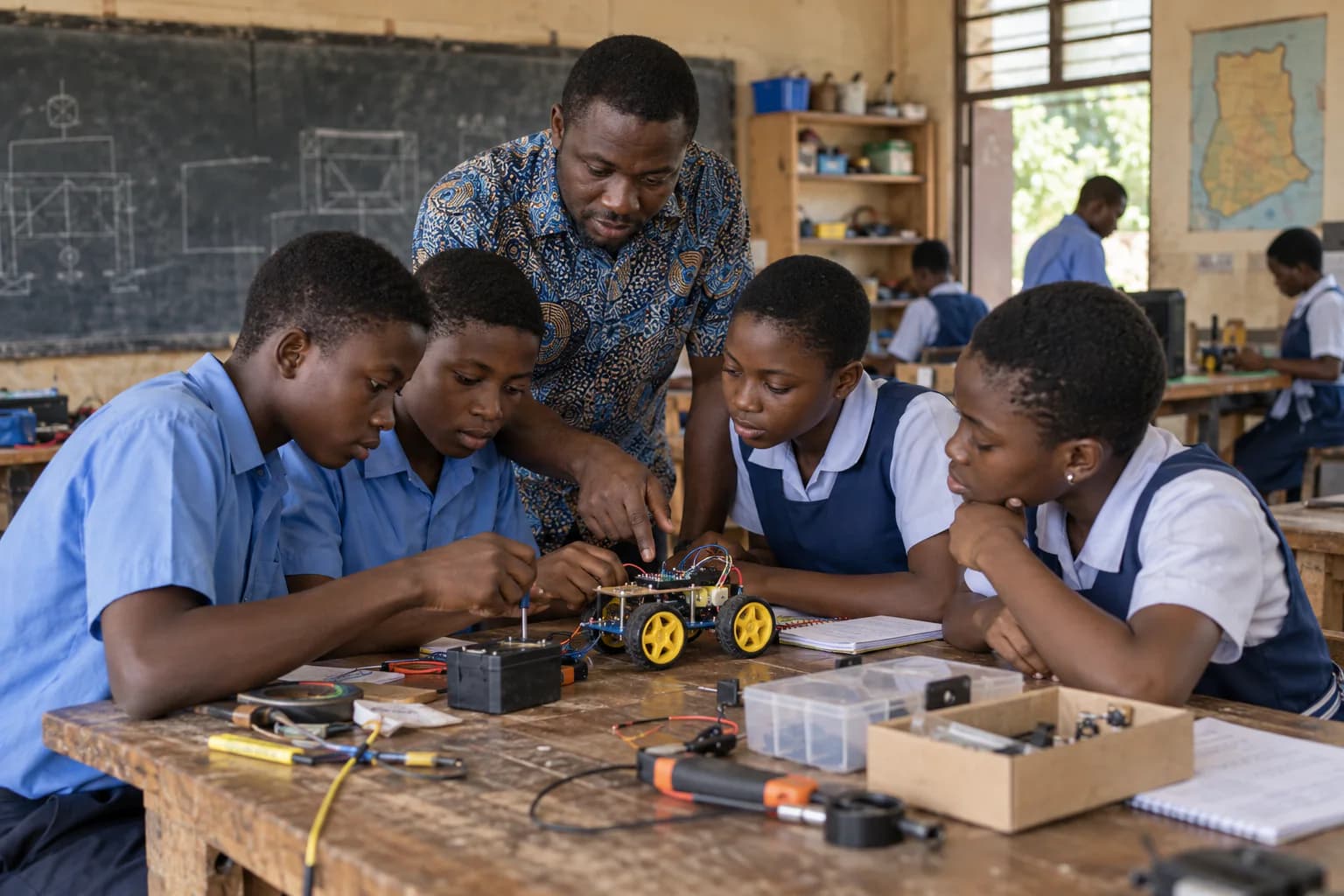
A STEM programme can produce strong photographs, large attendance numbers and weak institutional change at the same time. Development partners need an evaluation model that looks beyond visibility to the complete pathway from inputs to sustained capability.
The question is not whether activity happened. It is whether a stronger learning system remains because it happened.
1. Relevance
Is the programme anchored in a clearly defined learning problem? Does it align with national curriculum and institutional priorities? Were teachers, learners and school leaders involved in defining the response? Technology should earn its place by serving the objective.
2. Equity
Disaggregate participation and progression by gender, disability, geography, school type and other relevant barriers. Examine who receives hands-on roles, who returns, who completes and who reaches the next opportunity. Presence is not the same as meaningful participation.
3. Learning quality
Look for learner artefacts, demonstrations, explanations, assessment rubrics and evidence of iteration. A robotics programme should show engineering judgement; a coding programme should show prediction, debugging and transfer; an AI programme should show critical verification and responsible use.
4. Teacher and institutional capability
Can local educators deliver, adapt and troubleshoot the programme? Is capability distributed across a team? Are planning time, coaching and communities of practice funded? If implementation depends permanently on an external expert, scale will remain fragile.
5. Operational feasibility
Test the ordinary day: power interruptions, shared devices, staff changes, delayed consumables, weak connectivity and equipment failure. UNICEF’s implementation research in Ghana highlights appropriateness, adoption, fidelity and feasibility as connected dimensions—not separate afterthoughts.
6. Safeguarding and governance
Review child protection, consent, learner data, images, platform terms, responsible AI, accessibility, incident response and procurement conflicts. Governance should be visible in routines and responsibilities, not only in a policy document.
7. Sustainability and scale
Ask what must continue, who will own it and what it will cost. Distinguish replication from scale: copying activities into more schools is not scale if quality, support and local ownership collapse.
A practical evidence stack
- Reach: verified participation and dosage.
- Experience: whether learners and teachers found the model appropriate and usable.
- Capability: what participants can now do and explain.
- Practice: whether new routines appear in classrooms and institutions.
- Progression: what participants do next.
- Durability: what remains after external support reduces.
Red flags during due diligence
- Equipment quantities are clear but learner outcomes are vague.
- Reach figures have no definition, reporting period or attendance threshold.
- Teacher training is measured only by workshop completion.
- Scale assumptions ignore recurring costs and local support capacity.
- Inclusion is reported through photographs rather than disaggregated progression.
- The provider cannot explain what failed or changed during implementation.
Fund learning, not certainty theatre
Partners should expect a clear theory of change and responsible evidence, while leaving room for adaptation. A programme that reports only success is probably hiding the information needed to improve.
Download the Development Partner STEM Due Diligence Guide. Use it with the Gender Inclusion Audit for STEM Programmes to test participation beyond headcounts.
The proposal can be persuasive while the programme remains fragile
STEM proposals naturally foreground aspiration: future jobs, innovation, inclusion and national competitiveness. Those goals are important, but they do not reveal whether the programme will work on an ordinary Tuesday in an ordinary school. Evaluation must travel from the promise to the operating conditions that make the promise plausible.
A programme is fragile when it depends on exceptional trainers, uninterrupted connectivity, unpaid teacher effort, imported replacement parts or permanent donor coordination. These dependencies should appear in the investment decision before launch—not in the final evaluation as surprising lessons.
Evaluate the causal chain, not the activity list
Ask the provider to complete this sentence: “If we do these activities, these actors will change these practices, which will produce these learner capabilities, because these conditions will hold.” Each link needs evidence or an explicit assumption. This simple exercise exposes programmes that leap directly from workshops delivered to economic transformation.
The chain also clarifies what should be measured. If teacher practice is the mechanism, training attendance is insufficient. If sustained access is the mechanism, devices delivered are insufficient. If problem-solving is the outcome, participant satisfaction is insufficient.
Due diligence should include the people expected to sustain the work
- Teachers should explain timetable and preparation realities.
- School leaders should identify budget, storage and accountability ownership.
- Learners should describe who participates and who becomes an observer.
- Local technical teams should test maintenance and replacement assumptions.
- Government or system actors should assess curriculum and policy fit.
A stronger definition of scale
Scale is not the replication of activity. It is the preservation of essential quality while ownership broadens and unit dependency on the original provider falls. Development partners should fund the architecture of that transition: local leadership, evidence routines, adaptable standards, maintenance capacity and honest learning. A programme worthy of expansion should become more locally capable as it grows, not more dependent on external rescue.
The questions I would take into an investment committee
What must still be true three years after the grant closes? Which capability will exist locally that does not exist today? What is the programme learning fast enough to change? Which headline claim carries the greatest uncertainty? And if the pilot succeeds, which part of that success is actually reproducible? These questions shift discussion from confidence in the proposal to confidence in the system being built.
The best implementation partners will welcome that scrutiny. They will distinguish evidence from assumption, name risks before being asked and show how local actors gain authority—not merely responsibilities—as the programme matures.
Evidence from delivery, policy and product development
My perspective comes from operating on several sides of the system: leading InovTech’s delivery across more than 100 schools, developing education technology for low-resource settings, contributing as a stakeholder to Ghana’s secondary curriculum development and national science, technology and innovation policy review, and participating in the UNCTAD national workshop on science, technology and innovation park policy.
InovTech has also delivered innovation-driven education work connected to the World Bank’s Mobilizing Support for Social Sustainability in Africa initiative. The practical lesson is that a strong intervention must satisfy different forms of legitimacy at once: it must make sense to a learner, be teachable by an educator, operable by a school, relevant to public policy and credible to a funder.
International media attention from CNN and Voice of America helped make the mission visible. But visibility is not the same as institutional readiness. Development partners should look behind a compelling founder story and test whether the organisation has the people, systems, evidence and governance to turn attention into durable public value.