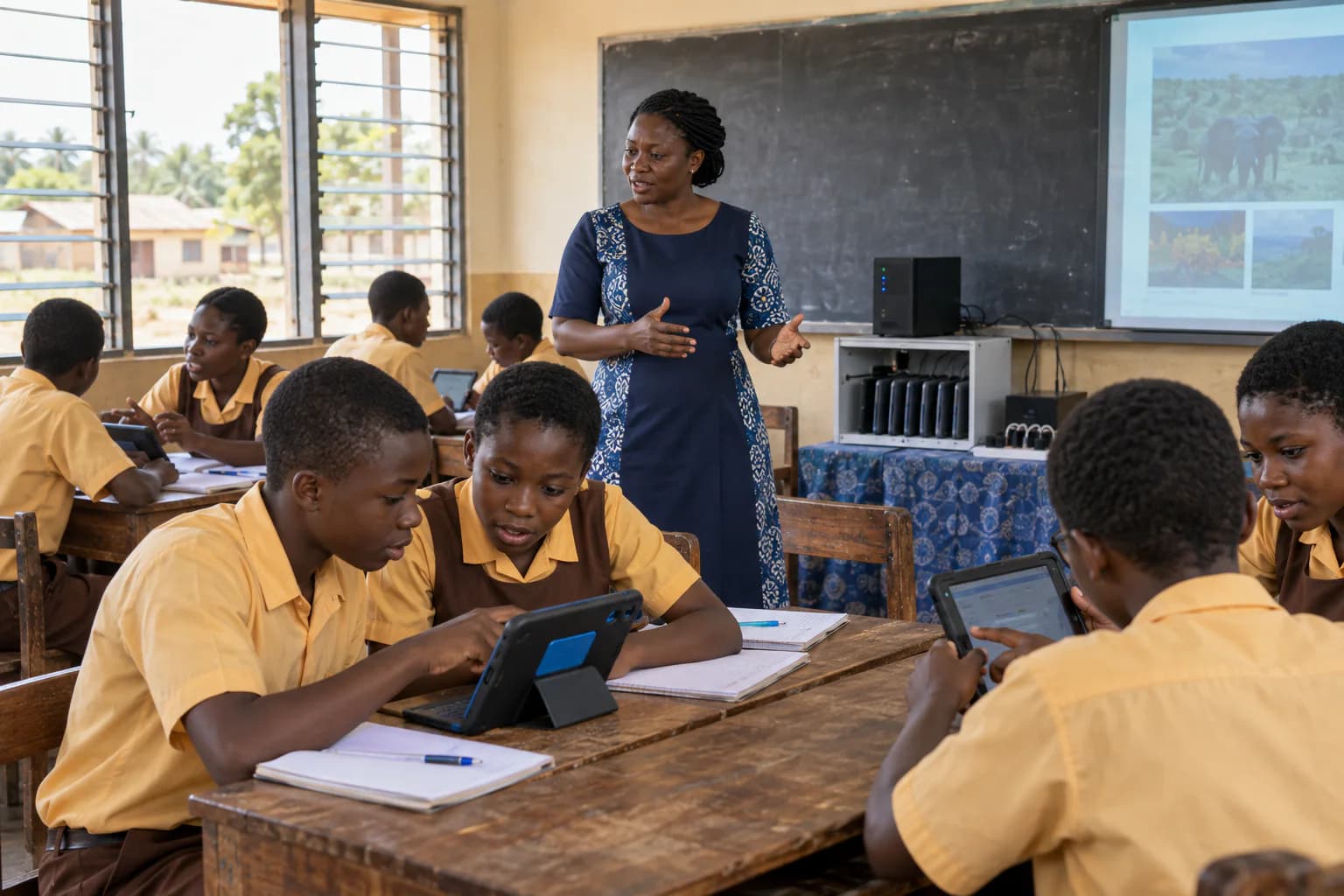
Building technology from Ghana teaches a useful discipline: the product cannot hide behind ideal conditions. Connectivity varies. Devices are shared. budgets are constrained. Institutions adopt slowly. Users develop ingenious workarounds. Imported assumptions surface quickly.
These realities are sometimes described only as barriers. I see them as engineering information. They force a builder to identify what is essential, who carries the operational burden and whether the product can create value when the environment is imperfect.
African context is not a market-localisation step after the product is built. It is part of the product specification.
Lesson 1: design around the complete workflow
A feature can work while the product fails. In education, the learner interface is only one layer. A teacher must plan, organise access, observe progress, recover from errors and connect the activity to curriculum. A school leader must schedule, budget and maintain. If the product ignores these workflows, adoption depends on heroic individuals.
Lesson 2: resilience is a feature
Offline support, local caching, graceful recovery, low data use, shared-device modes and clear status feedback are not secondary requirements. They determine whether the same learner can continue tomorrow. Systems designed for resilience also become stronger in emergencies and underserved markets elsewhere.
Lesson 3: the user and the buyer may be different
A learner may use the product, a teacher may enable it, a school may operate it, a parent may influence trust and a development partner may fund it. Each actor has a different definition of value. Product strategy must identify the adoption coalition, not only the end user.
Lesson 4: affordability is an operating model
Low price does not guarantee access. Total cost includes devices, connectivity, training, support, time, repairs and replacement. The strongest products reduce the cost of repeated meaningful use. That may require virtualisation, modular hardware, local support or institutional licensing—not simply a cheaper unit.
Lesson 5: distribution belongs inside product design
A technically impressive product without a trusted route to users is unfinished. Schools and public institutions have calendars, approval chains and evidence needs. Community organisations bring trust. Telecommunications and device partners can change access economics. These relationships should shape the roadmap early.
Lesson 6: local relevance must survive scrutiny
Adding African images or examples is not localisation. Relevance reaches the underlying problem, language, incentives, workflow, risk and definition of success. It also means testing whether a local problem is important enough that someone will change behaviour or allocate budget.
Lesson 7: evidence should begin before scale
Founders often postpone measurement until growth. By then, the product may have scaled activity without understanding value. Define the behaviour and outcome that should change; record a baseline; instrument meaningful use; collect qualitative evidence; and state what result would challenge the hypothesis.
Lesson 8: institutions must be able to own the system
If every implementation depends on the founder, the product has not scaled. Documentation, onboarding, permissions, support, training and failure recovery should allow ordinary teams to operate successfully. Founder independence is a product milestone.
A practical African product test
- Does it work on the devices people already have?
- What happens when connectivity disappears midway?
- Can a new staff member understand the workflow?
- Who fixes it, and with what parts or information?
- Which data is collected, where does it go and who can challenge its use?
- What cost recurs after the pilot?
- What evidence demonstrates value to the user and the buyer?
The larger lesson
Africa should not be treated as a simplified version of another market. It is a demanding design environment with the potential to produce globally stronger systems. Build close to the problem. Make constraints explicit. Protect human agency. Design for continuity. And treat local institutions as owners—not distribution endpoints.