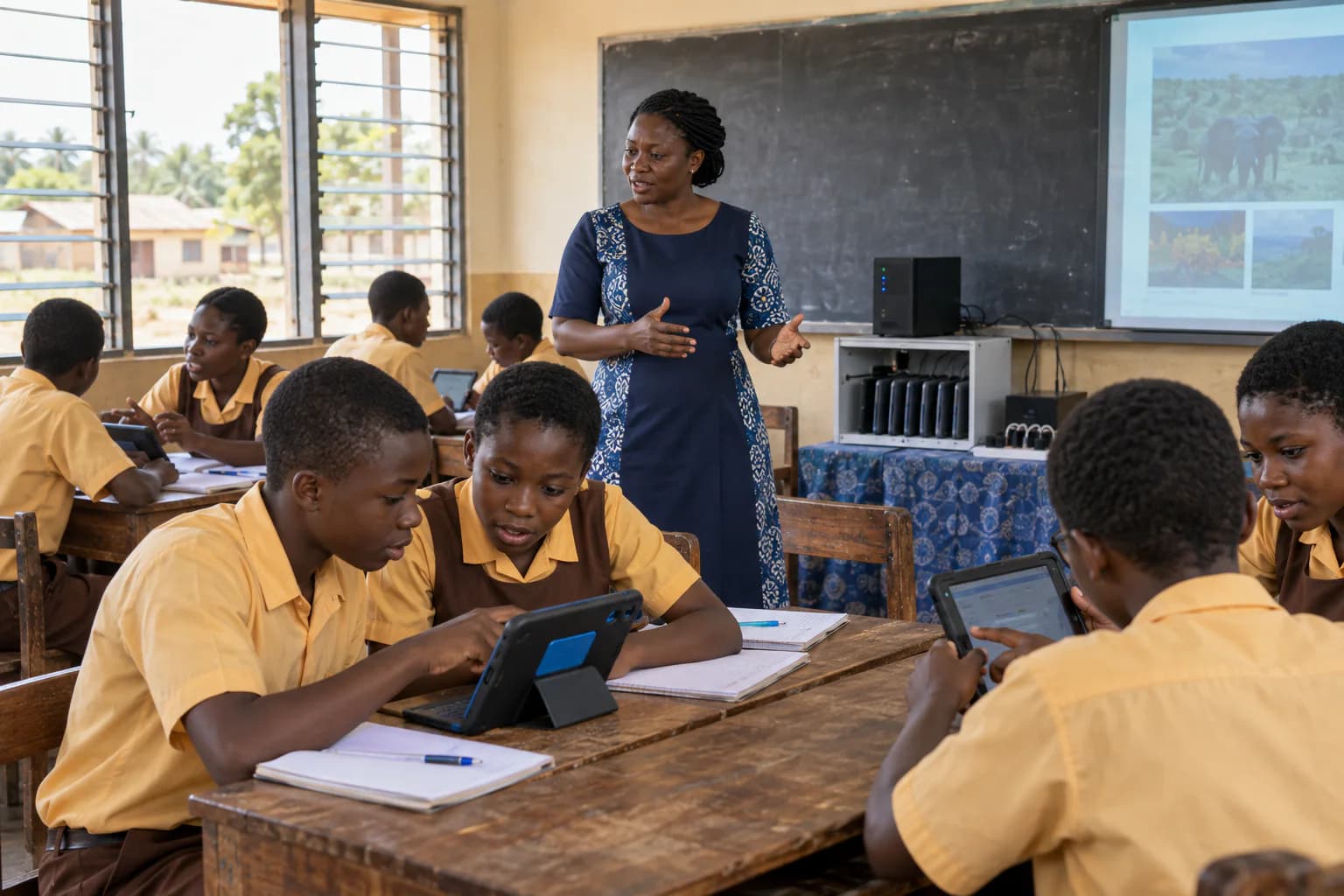
Technology products are never context-free. A learning platform designed around one-device-per-child, reliable broadband, private study space, subscription payments and abundant technical support contains those assumptions even when they are not written in the product brief.
When African education systems import the visible product without examining the invisible operating model, failure is blamed on teachers, learners or “resistance to technology.” The design itself often deserves more scrutiny.
Localisation is not changing names, illustrations and currency. It is redesigning the system around different realities, incentives and institutions.
The assumption audit
Before adopting or adapting an EdTech model, audit six layers:
- Infrastructure: power, connectivity, devices, maintenance and physical security.
- Institution: timetables, class size, curriculum, procurement, data governance and accountability.
- Educator: workload, confidence, incentives, support and professional agency.
- Learner: language, prior knowledge, disability, access outside school and household responsibilities.
- Economics: who pays, in which increments, through which channel and how total ownership changes at scale.
- Evidence: whether the original result transfers to this population and implementation model.
Five common transplantation failures
Licence without implementation: institutions buy access but underfund teacher development and support. Content without curriculum: a large library creates search burden without clear progression. Personalisation without diagnosis: an algorithm recommends more activity but cannot explain the learner's misconception. Analytics without action: dashboards report problems no one has time or authority to address. Pilot without ownership: external teams create an exceptional environment that disappears when funding ends.
What should be borrowed
Africa should not reject ideas because they originated elsewhere. Strong assessment methods, accessibility practices, open standards, research evidence and software patterns can travel. The question is what must remain stable and what must be redesigned.
Borrow principles. Validate mechanisms. Rebuild workflows. Measure outcomes locally.
Africa is not one implementation context
Designers should avoid replacing “Western user” with an equally fictional “African user.” Conditions differ between and within countries, cities, schools, languages and income groups. Good local design creates a method for discovering variation rather than relying on stereotypes.
The local operating model canvas
- Who owns the learning problem?
- Which existing routine must change?
- What does the teacher do before, during and after use?
- What is the minimum viable infrastructure?
- How is content aligned, reviewed and updated?
- Which data leaves the institution?
- Who supports failure at 10, 100 and 1,000 schools?
- What evidence triggers adaptation, scale or retirement?
The larger opportunity
African education systems are not merely difficult markets for existing EdTech. They are environments in which stronger models can emerge: offline-first, teacher-centred, multilingual, collaborative and designed around institutional durability. Products that succeed honestly under these conditions can become globally important.
The five levels of adaptation
- Cosmetic: names, images, currency and spelling change.
- Content: curriculum, examples, languages and assessment change.
- Workflow: grouping, teacher roles, timetables and support change.
- Architecture: offline behaviour, device assumptions, identity and data flows change.
- Institution: procurement, governance, financing, evidence and ownership change.
Many “localised” products stop at level one or two. Durable adoption usually requires work at all five.
The transplant stress test
Take the original model's strongest result and list every condition surrounding it: class size, teacher preparation, device ratio, connectivity, language, implementation support, learner baseline, incentive, study duration and attrition. For each condition, mark same, adaptable, unknown or fundamentally different in the target context.
The unknowns become pilot questions. Fundamentally different conditions may require a new theory of change—not a translated interface.
The total-cost-of-adoption equation
Three-year cost should include licences, devices, connectivity, charging, installation, teacher time, training, coaching, administration, content alignment, data protection, technical support, replacements and exit. Divide by active learners completing meaningful use, not accounts created. Then calculate cost per learner demonstrating the intended outcome.
A localisation sprint
- Week 1: observe the existing school workflow without the product.
- Week 2: test language, curriculum and assessment fit with teachers.
- Week 3: simulate poor power, connectivity, device sharing and support delays.
- Week 4: run sessions with different school types and accessibility needs.
- Week 5: redesign the operating model, not only interface defects.
- Week 6: agree the smallest evidence pilot and stop conditions.
Contract clauses that protect institutional ownership
Require data export in usable formats, documented integrations, advance notice of major changes, a service-level agreement, incident notification, content ownership clarity, price-change limits during the pilot and an exit transition. Institutions should also retain access to learner evidence needed for continuity after a product leaves.
The most important transfer question
Ask: “Which mechanism produced the original result?” If the mechanism was intensive coaching, a cheaper self-service deployment is not the same intervention. If it was frequent individual practice, a shared-device weekly session may not reproduce it. Evidence travels through mechanisms, not brand names.