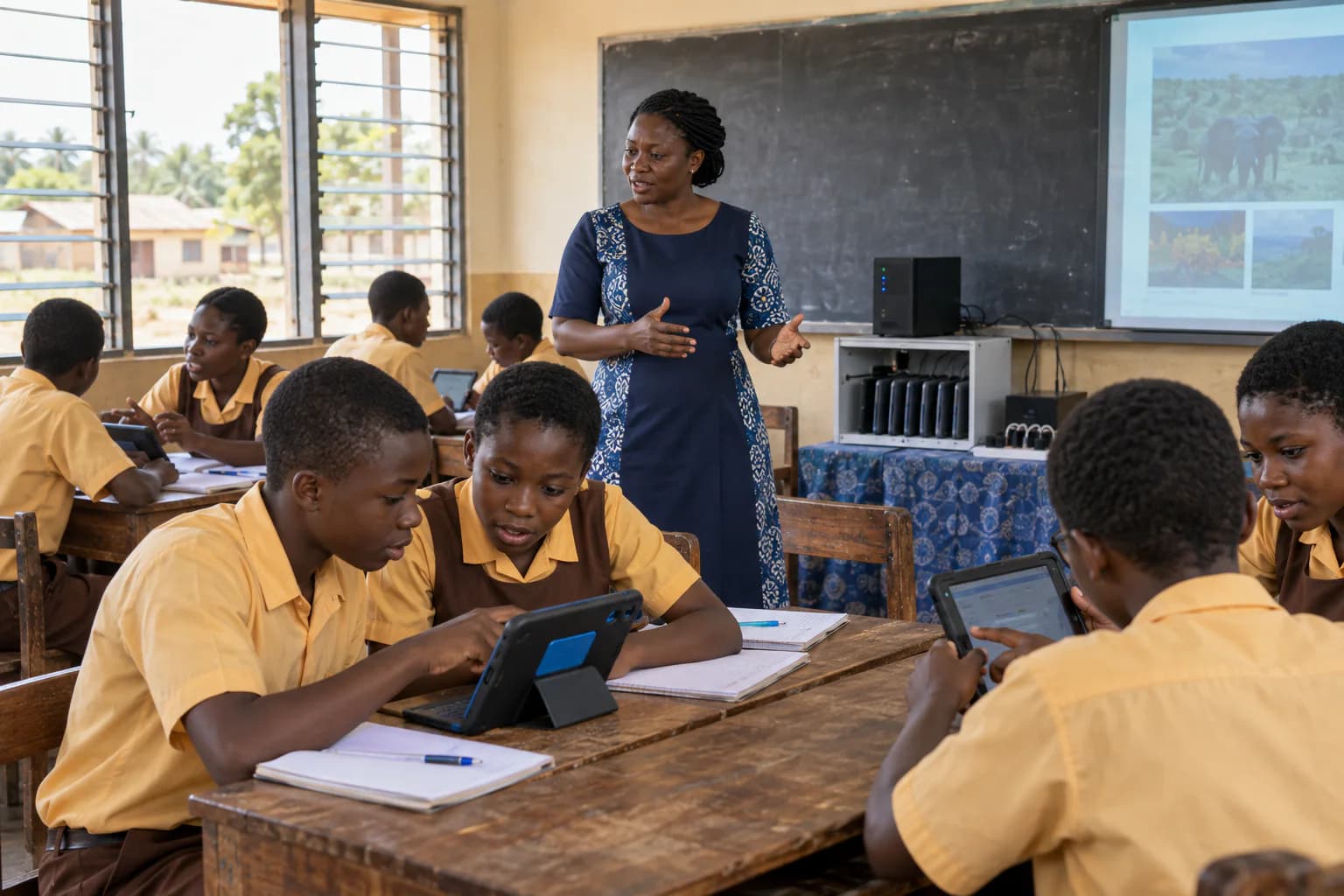
When an education platform stops working because the internet is slow, the lesson does not pause politely. The teacher loses time, learners lose focus, and confidence in the entire programme falls. This is why offline-first design should not be treated as a fallback for “difficult” schools. It should be a quality standard for resilient digital learning in Ghana.
Offline first does not mean offline only. It means the core learning experience remains useful without a continuous connection, then synchronises, updates, or expands when connectivity becomes available. The approach reflects how many schools actually operate and protects teaching from conditions the teacher cannot control.
Recent work on Ghana’s national EdTech direction explicitly recognises equitable, offline-first and mobile-first systems. That is an important shift: infrastructure reality is no longer a reason to postpone innovation; it becomes a design requirement for better innovation.
Resilience is a feature. A platform that works only under perfect conditions is not ready for a national classroom.
The four-part reliability test
I assess digital learning through four questions:
- Available: Can the lesson open when connectivity is absent or unstable?
- Usable: Can learners navigate it on shared, low-specification devices without unnecessary data or complexity?
- Teachable: Can the teacher see progress, organise groups, adapt the activity, and connect it to the curriculum?
- Maintainable: Can the school update content, replace common parts, recover data, and get support at a sustainable cost?
A product can look impressive in a demonstration and fail all four questions in practice. Procurement must test the ordinary day, not the ideal launch day.
Design around classroom routines
Offline-first learning works best when technology and pedagogy are designed together. A local classroom server can hold approved content and learner activities. Devices can connect over a local network. Learners can work in pairs or rotate through stations. Progress can be stored locally and synchronised later. The teacher can continue with printed or unplugged extensions when a device is unavailable.
The important design unit is not the individual app screen. It is the complete lesson: preparation, login or access, group organisation, instruction, activity, teacher observation, saving, feedback, and recovery when something fails.
UNICEF’s Ghana research on digital learning in real classrooms emphasises appropriateness, adoption, fidelity, and feasibility. These dimensions remind us that technical availability is only one part of educational reliability.
Shared devices can support deep learning
One-device-per-learner models have advantages, but they should not become the condition for meaningful digital education. Well-designed pair programming, group investigation, station rotation, and peer explanation can make shared access intellectually rich.
The key is role design. One learner might operate the device, another predict, another record evidence, and another check the result. Roles rotate. The screen becomes a shared object for reasoning, not a private source of answers.
Questions every buyer should ask
- What can a learner and teacher complete with no internet connection?
- What is the smallest and largest update, and who controls when it downloads?
- What happens to work when power fails or a device is replaced?
- Can content be aligned to Ghana’s curriculum and adapted without vendor intervention?
- Can teachers see and export evidence of learning locally?
- What are the recurring costs for data, licences, batteries, accessories, and support?
- How does the system protect learner data during local storage and later synchronisation?
Connectivity still matters
Offline-first design must not become an excuse to accept permanent disconnection. Ghana should continue investing in reliable school connectivity, electricity, devices, and public digital infrastructure. Connectivity expands collaboration, content, updates, support, and opportunity.
The point is sequencing and resilience. Learning should begin before perfect connectivity arrives, continue when connectivity fails, and become richer as infrastructure improves.
A Ghanaian advantage
Designing for constraint can create globally valuable products. Systems that are lightweight, teacher-controlled, shareable, repairable, and resilient are useful far beyond rural schools. They are useful during outages, emergencies, travel, and in any environment where technology must earn trust.
Offline first is not a lesser version of digital learning. Done well, it is disciplined engineering in service of educational continuity—and one of the clearest opportunities for Ghanaian innovators to lead.
Download the Offline AI Classroom Readiness Framework.
Resilience is a design quality, not an emergency feature
Programmes often design for the best available connection and create an offline workaround later. That reverses the priority. A resilient system begins by identifying the minimum learning experience that must remain possible, then adds connectivity where it expands value. This approach protects instructional time and makes failure predictable rather than catastrophic.
Offline-first does not mean offline-only
The strongest architecture can synchronise when connectivity appears, cache essential content, preserve learner work locally and give teachers visibility without demanding constant data. It also defines how updates, backups and security happen. Resilience requires more engineering, not less ambition.
Design against four interruptions
- Connectivity interruption: core tasks and resources remain available.
- Power interruption: the lesson can shift to low-power or unplugged modes without losing the concept.
- Device interruption: grouping and role design preserve meaningful participation.
- Support interruption: teachers can diagnose common faults and access local documentation.
The deeper equity argument
A system that works only under premium conditions quietly defines some learners as edge cases. Offline-first design rejects that hierarchy. It treats Ghanaian operating realities as first-class engineering requirements and can produce technology that is more robust anywhere. The goal is not to offer less because infrastructure varies. It is to design more intelligently so learning does not disappear when conditions change.
KodeVR grew from a classroom constraint, not a technology trend
The early problem was repeated across schools: learners wanted to practise robotics and coding, but available platforms assumed continuous internet, higher-specification computers or access to expensive physical kits. Those assumptions were not minor usability problems. They determined who could participate.
KodeVR was built as a mobile-first virtual robotics and coding environment for lower-resource settings and now has 10,000+ active learners. Its purpose is not to celebrate working with less. It is to ensure that unreliable infrastructure does not decide which child is allowed to begin.
We are not waiting for perfect infrastructure before building the people who will improve it.
The next technical challenge is to make offline-first systems increasingly observable and adaptive: safe local storage, intelligent synchronisation, teacher dashboards that tolerate intermittent connectivity and evidence that learning transfers beyond the platform. Resilience should become a source of African product leadership, not a footnote to products designed elsewhere.