Africa will use artificial intelligence whether or not it becomes a major producer of it. The strategic choice is whether the continent remains primarily a customer of systems shaped elsewhere or develops enough technical, institutional and market capacity to influence what AI optimises, whom it serves and where the value accumulates.
To build does not mean every African organisation must train a frontier model. It means Africa must own meaningful parts of the intelligence value chain.
What building actually means
Building includes collecting and governing relevant data; creating language resources; adapting efficient models; designing products around African workflows; evaluating performance locally; integrating systems; conducting assurance; contributing research; manufacturing supporting infrastructure where viable; and building companies that retain intellectual property and expertise.
The cost of consumption-only AI
- Representation risk: languages, contexts and needs remain weakly reflected.
- Economic leakage: subscription and infrastructure value flows outward while local firms remain implementers.
- Capability dependency: institutions cannot inspect, adapt or recover systems independently.
- Policy weakness: governments regulate technologies they have limited ability to evaluate.
- Research loss: African problems supply use cases without producing durable local knowledge.
A realistic African production strategy
Africa should combine continental cooperation with national specialisation. Shared compute, research networks, interoperable data governance and regional markets can reduce fragmentation. Individual countries can build strength around sectors and languages where they have institutions, demand and knowledge.
Small and domain-specific AI deserves particular attention. Efficient models deployed on ordinary devices or controlled infrastructure can lower costs, improve privacy and make adaptation possible. The World Bank and UNESCO increasingly emphasise these practical foundations rather than assuming frontier-scale systems are the only path.
Five assets the continent must grow
- Talent density: deep mathematics, software, data, product and domain capability.
- Governed data commons: lawful, representative resources with community and public-interest safeguards.
- Compute access: infrastructure and partnerships that do not lock research and companies out.
- Early markets: procurement and industry partnerships willing to buy and evaluate African solutions.
- Assurance capacity: regulators, auditors, researchers and civil society able to test claims and investigate harm.
Education must produce agency
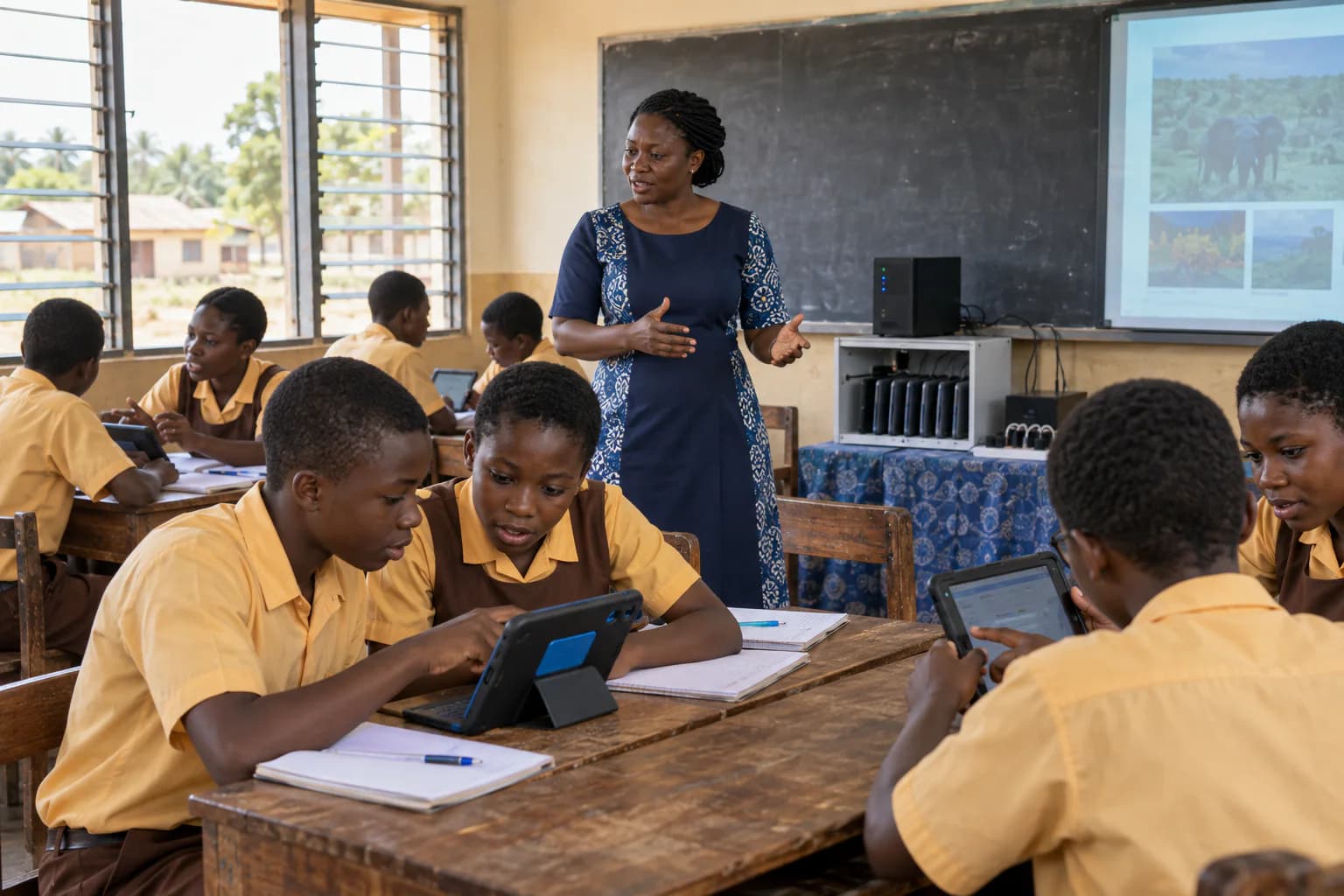
A continent of prompt users is not an AI-producing continent. Learners need the foundations to understand data, models, computation, uncertainty and ethics. Technical specialists need real systems experience. Domain professionals need enough fluency to define valuable problems and reject inappropriate solutions.
Build with openness and leverage
Strategic autonomy does not require isolation. Open-source software, international research and global platforms can accelerate African capability. The question is whether partnerships transfer knowledge, support local ownership, respect data rights and leave institutions stronger after the contract ends.
The continental prize
The African Union’s Continental AI Strategy provides the political frame. The economic and social prize is larger: products that understand African languages, improve essential services, create high-value work and give the continent a stronger voice in global technology governance.
Africa does not need to build everything. It must build enough to choose, adapt, govern and create.