The price of a STEM laboratory is not the price of the equipment inside it. A school can buy impressive tools and still fail to create a functioning learning environment. The true cost is the amount required to make practical STEM available, teachable, safe and maintainable for a defined number of learners over a defined period.
This is why responsible providers should resist giving a universal figure before understanding the school. Location, learner numbers, curriculum, existing infrastructure, power, security, teacher readiness, timetable and desired disciplines all change the model.
Do not ask only, “What will the lab cost to open?” Ask, “What will it cost to keep learning happening for three years?”
The total-cost equation
A practical budget should calculate: setup + people + recurring operations + maintenance and replacement + programme support + measurement + contingency. Each category should be attached to a learning objective and an owner.
1. Space and infrastructure
Begin with what already exists. Costs may include electrical work, ventilation, lighting, network coverage, secure doors, storage, work surfaces, seating, accessibility, fire protection and signage. A converted classroom can outperform a purpose-built room if its operating model is stronger.
2. Core learning tools
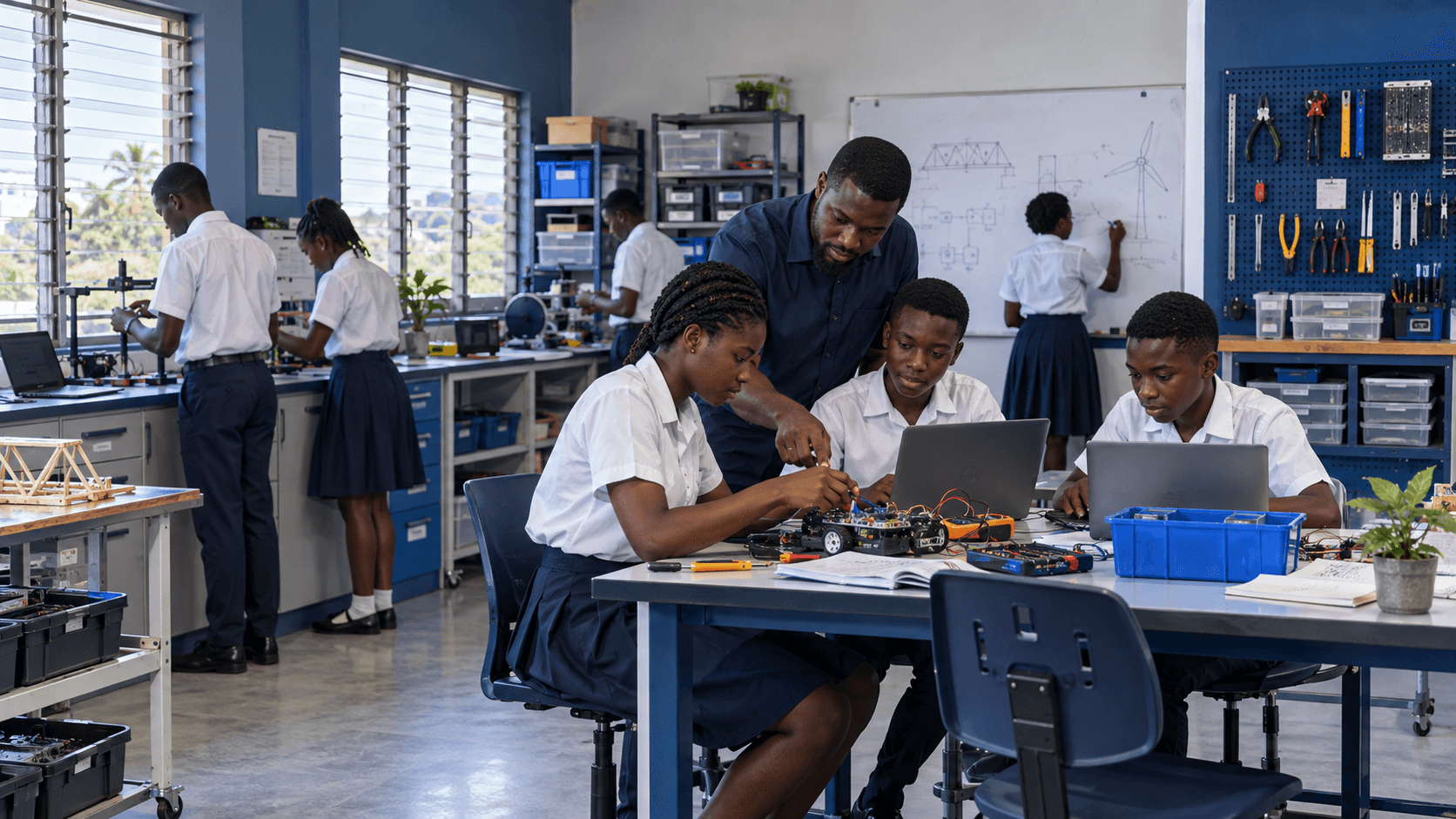
Specify tools by the number of simultaneous learning groups—not by the maximum school population. A blended inventory might include shared laptops, microcontrollers, sensors, robotics components, basic electronics, hand tools, measurement equipment, science materials and fabrication resources.
Interoperability matters. Proprietary parts that cannot be sourced or substituted locally can turn a small failure into months of inactivity. Standard components, transparent inventories and repair documentation reduce long-term risk.
3. Software, content and connectivity
Include licences, device management, local content storage, security, updates and internet data. Offline-first tools can protect teaching time, but “offline” still requires an update and support plan. Free software also has a cost when teachers need configuration, training or troubleshooting.
4. Teacher capability and planning time
This is frequently underfunded. Budget for baseline assessment, practical training, lesson rehearsal, classroom coaching, curriculum mapping, communities of practice and preparation time. If only one teacher is trained, staff movement can close the lab overnight.
5. Consumables, maintenance and replacement
Wires break, batteries degrade, sensors fail, adhesives finish and small components disappear. A school needs an inventory routine, fault-reporting process, approved suppliers, annual replenishment line and authority to make small repairs quickly.
6. Programme management and safeguarding
Account for scheduling, supervision, child protection, insurance where appropriate, technical support, accessibility and responsible data practices. These are not administrative extras. They determine whether learners can use the environment safely and consistently.
7. Measurement and learning
Budget for baseline information, learner portfolios, teacher observation, programme reviews and reporting. Counting participants is inexpensive; understanding whether capability improved requires better instruments and protected staff time.
Three viable models
- Foundational lab: computing, physical computing, basic electronics and portable science resources, designed for high utilisation and shared access.
- Integrated engineering lab: deeper robotics, fabrication, measurement and interdisciplinary projects, with stronger technical support.
- Hub-and-spoke model: a well-supported central lab serving surrounding schools through portable kits, teacher networks and scheduled access.
The best model is the one the institution can operate with quality. A smaller lab used every week is a better investment than a larger lab opened mainly for visitors.
Questions every quotation should answer
- Which learning outcomes and year groups does this specification serve?
- How many groups can work simultaneously?
- What must be replaced each term and each year?
- Which failures can the school repair locally?
- What teacher support is included after commissioning?
- What are the three-year operating and replacement assumptions?
Download the Sustainable STEM Laboratory Planning Workbook.
The honest answer
A responsible cost begins with a readiness audit, not a catalogue. Define the learner pathway, design the operating model and price the full system. That is how a school moves from buying a room to building capability.
The cheapest laboratory is not always the least expensive
A low quotation can become the most expensive option when it excludes teacher preparation, replacement parts, curriculum integration and local support. The relevant comparison is not purchase price against purchase price. It is cost per meaningful learner experience over the useful life of the programme. A smaller laboratory used every week may create more value than a spectacular facility that depends on one trained person or imported consumables.
Decision-makers should therefore request three numbers: the cost to open, the cost to operate for three years and the cost of recovering from predictable failure. If the third number is unknown, the proposal has not yet confronted reality.
Three laboratory archetypes—and the trade-offs
A mobile model can serve several schools and reduce duplicate equipment, but transport, scheduling and ownership become critical. A school-based model supports regular practice and curriculum integration, but demands stronger local operations. A hub-and-spoke model combines a well-equipped centre with lighter school kits and virtual practice, but only works when progression between the hub and classroom is deliberately designed.
There is no universally superior model. The right architecture depends on learning frequency, geography, teacher distribution, maintenance capacity and who will carry recurring costs after the initial funder exits.
The procurement questions that change the outcome
- Which learning outcomes require this particular tool?
- How many groups can work simultaneously during a normal lesson?
- Which components are expected to fail first, and where are replacements sourced?
- What percentage of the three-year budget develops people rather than purchases objects?
- Who has the authority and budget to solve a small problem before it becomes a closed laboratory?
My investment test
I would approve a STEM laboratory only when the proposal can explain the journey from room to timetable, timetable to teacher practice, teacher practice to learner work and learner work to measurable progression. The room is the visible part of the investment. The operating model is the part that produces value.
From scraps to systems: why my view of cost is different
My first experiments did not begin in a fully equipped laboratory. I learned in an internet café and built early robots from discarded materials, old wires and parts recovered from broken objects. That experience taught me two lessons that still shape InovTech. First, limited resources do not imply limited intelligence. Second, improvisation is a powerful beginning but a poor substitute for a dependable education system.
This is why I resist both extremes: the belief that excellent STEM requires a glamorous room, and the belief that teachers should permanently “make do” without proper tools or support. A sustainable laboratory combines resourcefulness with institutional discipline. The equipment must be sufficient, but the timetable, teacher capability, repair route and recurring budget determine whether it becomes educational infrastructure.
The practical response has included building physical school programmes while developing KodeVR, a mobile-first virtual robotics and coding platform now serving 10,000+ active learners. The lesson is not that virtual tools replace laboratories. It is that smart programme architecture can reduce pressure on scarce hardware while protecting regular practice.