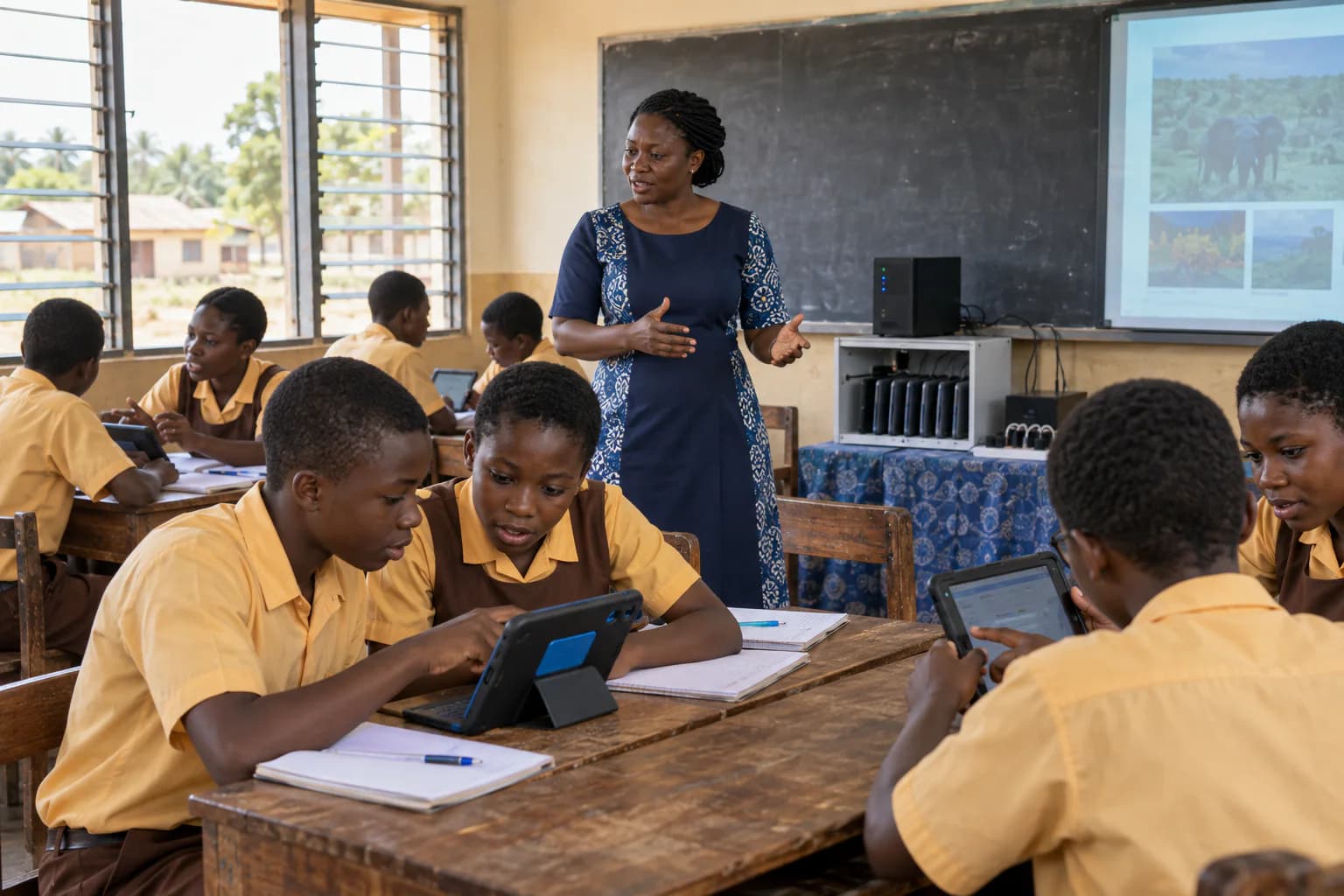
If Africa defines AI readiness as one learner, one laptop and permanent broadband, millions of capable young people will be classified as “not ready” for reasons that have nothing to do with their intelligence.
That would be more than an infrastructure mistake. It would be a talent strategy failure. Artificial intelligence will shape work, public services, media, agriculture, health and education long before connectivity becomes equal. Schools therefore need an approach that begins with judgement and concepts, works under interruption, and grows richer as infrastructure improves.
Offline AI education is not a promise that every advanced model can run on every device. It is a design principle: preserve the essential learning outcome when the network is absent, then use connectivity deliberately for updates, collaboration and tasks that truly require it.
African AI readiness should be measured by the quality of human judgement, not the permanence of a Wi-Fi signal.
Separate AI literacy from AI consumption
Learners can understand classification, pattern recognition, training data, error, bias, probability, automation and human accountability without beginning inside a chatbot. They can sort physical objects, design decision rules, compare human labels, inspect a small dataset, role-play a recommendation system and debate who is harmed when a model is wrong.
These activities are not substitutes for using real systems. They establish the mental models that make later tool use intelligent. Without them, learners can become fluent consumers of generated answers while remaining unable to explain why the answers fail.
The LOCAL AI classroom architecture
I use the acronym LOCAL to design resilient AI learning:
- Learning objective: name the human capability the lesson must reveal.
- Offline core: preserve explanation, comparison, verification and creation without continuous internet.
- Controlled connection: connect only for the model interaction, update or collaboration that adds value.
- Accountable judgement: require a named person to verify consequential outputs and protect learner data.
- Learning evidence: capture what the learner predicted, tested, changed and can now explain.
This architecture prevents a common error: designing the lesson around the tool’s availability rather than the learner’s thinking. It also helps schools distinguish three modes—fully unplugged foundations, locally available digital experiences and selectively connected AI use.
Design the complete lesson for interruption
Resilient AI lessons include a continuity plan. Approved prompts, sample outputs and small datasets can be stored locally. Learners can analyse previously generated outputs when live access is unavailable. A teacher device can support a whole-class comparison before small groups continue offline. Local servers or school networks can distribute resources without consuming internet data.
The critical design unit is not the app screen; it is the lesson sequence. What happens before connection? What requires connection? What work continues if the connection fails? Where is progress stored? How does the teacher see evidence? A programme that cannot answer those questions has outsourced educational continuity to the network.
Privacy must work offline and online
Weak connectivity does not reduce the obligation to protect children. Schools should minimise the personal data collected, avoid entering identifiable learner information into unapproved systems, define local storage and deletion rules, secure synchronisation and explain to families how AI is used.
Human review is equally important. An offline model can still be biased, inaccurate or inappropriate. Local execution may reduce some data exposure, but it does not make an output trustworthy. Teachers and learners should practise disclosure, verification, comparison and correction in every mode.
Procure for resilience, not demonstrations
Buyers should test products under ordinary classroom conditions: low-specification devices, shared access, loss of connectivity, power interruption and delayed technical support. The vendor should demonstrate:
- what remains functional without internet;
- minimum hardware and storage requirements;
- how content, models and security updates are distributed;
- how learner work is stored, exported and deleted;
- how teachers supervise use and recover from failure; and
- the total recurring cost of data, licences, support and replacement.
A strategic advantage for African builders
Designing for constraint can produce stronger products. Lightweight interfaces, local control, shared-device pedagogy, transparent data flows and graceful failure are valuable in every market. African education technology should not imitate systems built for perfect conditions and then remove features until they fit. It should begin with resilience as a premium feature.
The continent’s opportunity is not merely to catch up in AI adoption. It is to lead in responsible, infrastructure-aware AI education—building learners who understand systems before depending on them and products that remain useful when reality refuses to cooperate.
Download the Offline AI Classroom Readiness Framework (PDF) for lesson design, procurement, privacy and continuity checks.