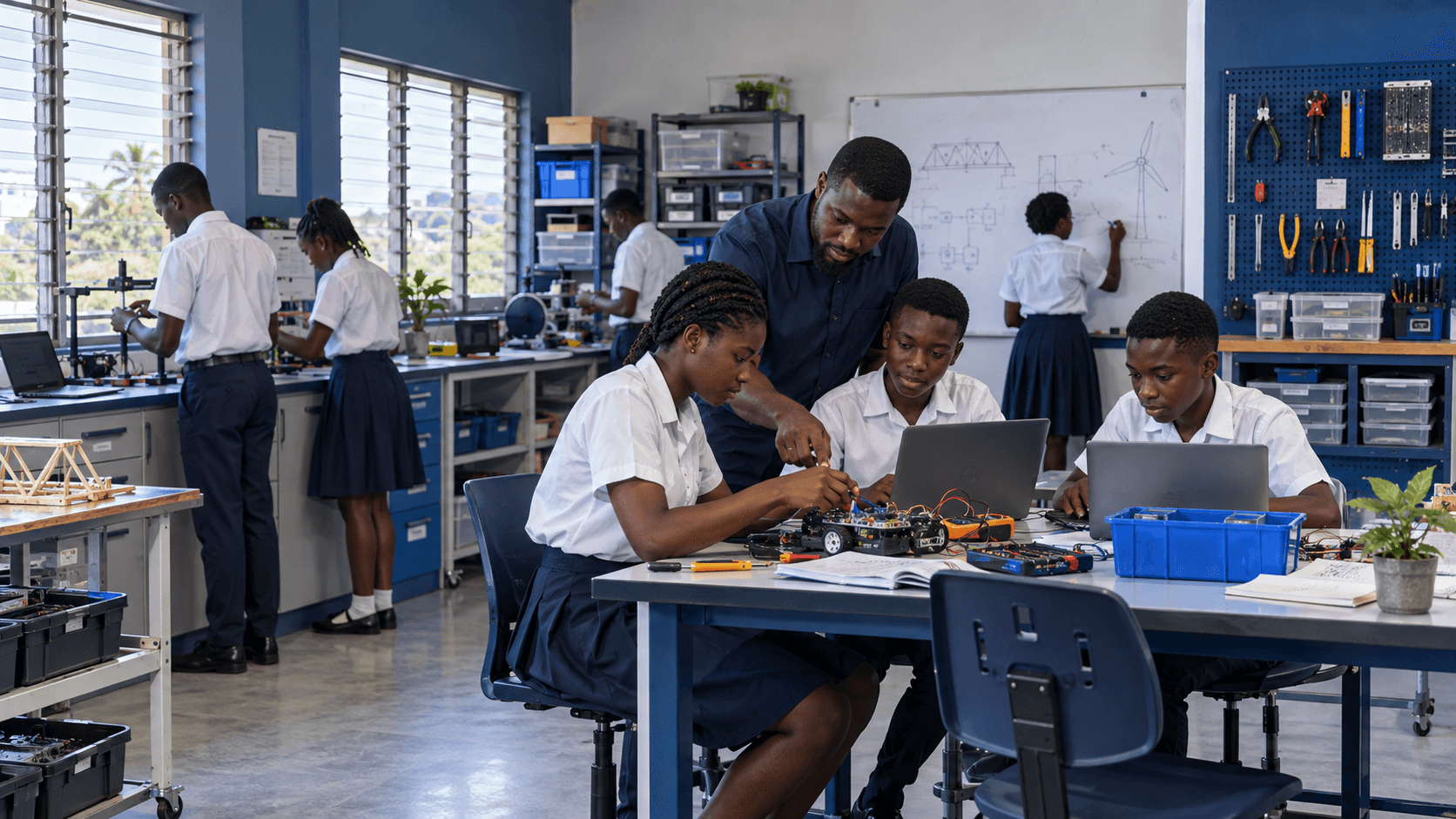
The most expensive STEM investment is often not the one with the highest price. It is the one that opens with applause, operates for a term, and then becomes a locked room of ageing equipment.
Across Ghana and Africa, the affordability conversation is too often reduced to unit price: the cost of a laptop, robot, sensor or 3D printer. That number is easy to compare and easy to approve. It is also a weak predictor of educational value. A low-cost kit used twice is expensive. A carefully selected tool used by hundreds of learners, supported by confident teachers and connected to a visible learning pathway can be a strong investment even when its purchase price is higher.
The better question is not, “How cheaply can we equip a room?” It is, “What is the least-cost operating architecture capable of producing the learning we value, at the quality and frequency we require?” That shift changes procurement from shopping into systems design.
Affordability is not a discount. It is the disciplined conversion of scarce resources into durable capability.
Start with the capability promise
Before selecting equipment, leaders should write a one-sentence capability promise. For example: “By the end of junior high, every learner will be able to define a local problem, build and program a working prototype, test it against evidence, and explain the trade-offs in the design.” This is more useful than a shopping list because it establishes what the investment must make possible.
The promise should specify the learners, the progression, the frequency of practice and the evidence expected. A school that wants broad foundational exposure needs a different model from one creating an advanced engineering pathway. A district programme serving shared devices needs a different operating plan from a specialist private laboratory. Technology should follow the promise.
The five-layer investment architecture
I use five layers to test whether a STEM investment is affordable in the only sense that matters: whether the school can operate it long enough to produce capability.
- Learning architecture: curriculum alignment, progression, project sequence, assessment and learner evidence.
- People architecture: teacher diagnosis, preparation, coaching, peer leadership and technical support.
- Access architecture: timetable, group size, device-sharing model, inclusion and practice frequency.
- Operating architecture: storage, charging, inventory, consumables, repair, replacement and safeguarding.
- Evidence architecture: what leaders will measure, review and use to improve the next cycle.
Equipment sits inside these layers; it is not a sixth layer floating above them. When budgets are constrained, this architecture helps leaders protect the essentials. A smaller set of tools with a strong timetable and capable teachers often produces more learning than a larger inventory without an operating model.
Use cost per meaningful learner experience
Purchase price hides utilisation. A more honest metric is cost per meaningful learner experience: total three-year programme cost divided by the number of learning sessions in which a learner actively designs, builds, codes, tests or explains.
Total cost should include space preparation, hardware, software, connectivity, teacher time, coaching, consumables, maintenance, replacement, programme coordination, safeguarding and evidence. Meaningful experiences should exclude passive demonstrations and ceremonial attendance. The metric is not perfect, but it exposes two realities that price-per-kit misses: underused equipment is costly, and teacher capability improves the productivity of every tool.
Leaders should also model three scenarios—expected use, half-use and disruption. If the investment case collapses when one teacher transfers, internet access fails or replacement parts take eight weeks, it is not yet resilient enough.
Standardise interfaces, not imagination
Schools can reduce cost by choosing a small number of interoperable platforms, common components and repeatable classroom routines. Standardisation makes spare parts, teacher training and lesson sharing easier. But the projects should remain open enough for learners to investigate water, agriculture, health, energy, accessibility, transport and other systems that matter locally.
Reuse is another strategic advantage. Cardboard, timber offcuts, bottles and locally available materials can carry the mechanical structure while electronics are reserved for the sensing and control functions that genuinely require them. This is not “low-tech STEM.” It is engineering discipline: use the simplest material that satisfies the requirement.
Protect the costs that create continuity
When budgets tighten, programmes often cut coaching, consumables, maintenance and measurement first because these costs are less visible than hardware. That decision protects the photograph and weakens the learning. A sustainable budget should ring-fence:
- teacher rehearsal and classroom coaching;
- consumables and frequently failing components;
- a repair and replacement reserve;
- offline or locally hosted learning resources;
- programme coordination and timetable protection; and
- evidence collection tied to real management decisions.
A board-level decision rule
Approve a STEM investment only when leaders can answer four questions with evidence: What capability will learners develop? How often will they practise? Who can operate and improve the model without the vendor? What recurring cost keeps it alive?
If one answer is missing, the proposal is not affordable yet—regardless of the quotation. The goal is not to make world-class STEM education look cheap. It is to make every cedi work harder by investing in the complete system that turns tools into teaching and teaching into capability.
Download the STEM Investment and Cost-of-Inaction Board Framework (PDF) to compare options, calculate three-year operating cost and test sustainability before approval.